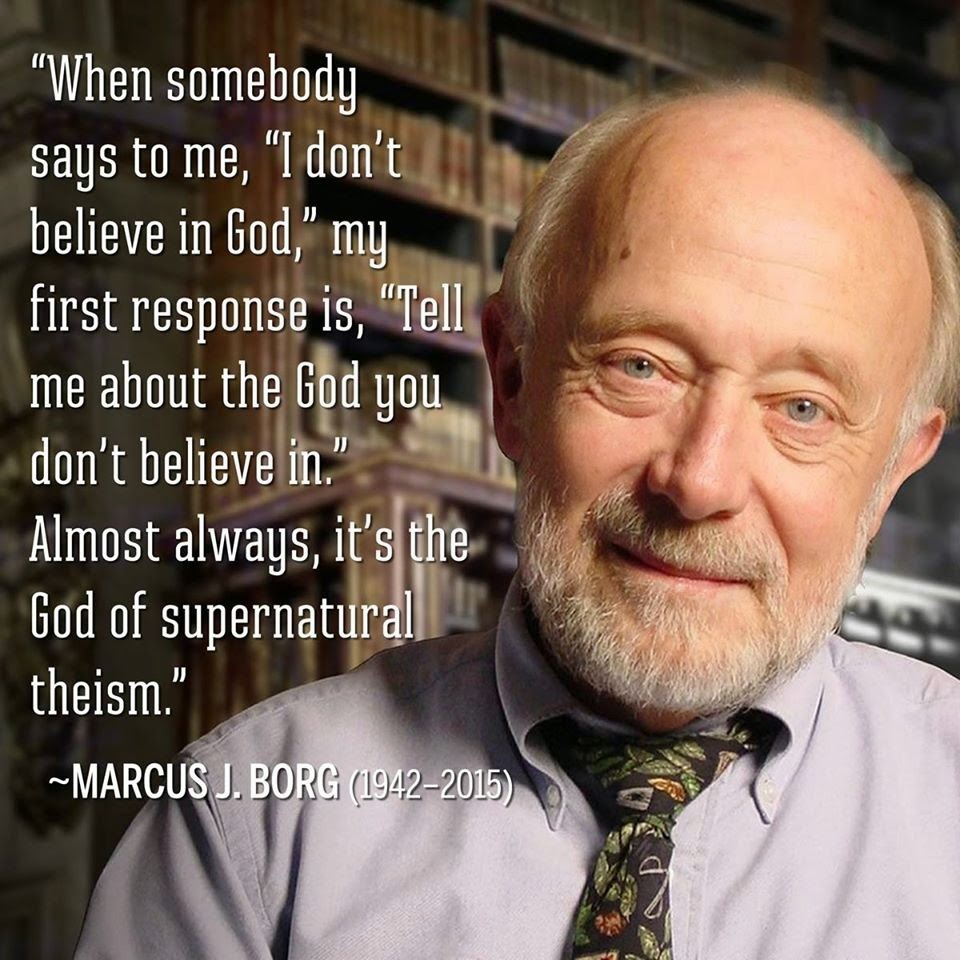
To start off, I really like Marcus Borg. His works are amazing, and I’ve learned a lot from what he has done.
I will be diving much more into this later on, but Borg is pretty right on here. Supernatural theism is something relatively new. It’s the idea that God is somewhere out there, as opposed to being more personal.
This view, which really latches onto the transcendence of God, that God is completely other, that God is out there somewhere beyond the universe. But this God at times intervenes in human life. This makes the question of evil so much more difficult as why didn’t God answer the prayers of the Jews during the Holocaust, but answer the prayer of my neighbor for a bit of rain.
This God is so other that it raises so many issues, and often leads to atheism.
Borg instead proposed panentheism, in which God is both transcendent and immanent. God is both part of everything, but is also more than everything. So you get this God that is much more personal.
I’ll dive all of this much more later on as it really is a large topic.
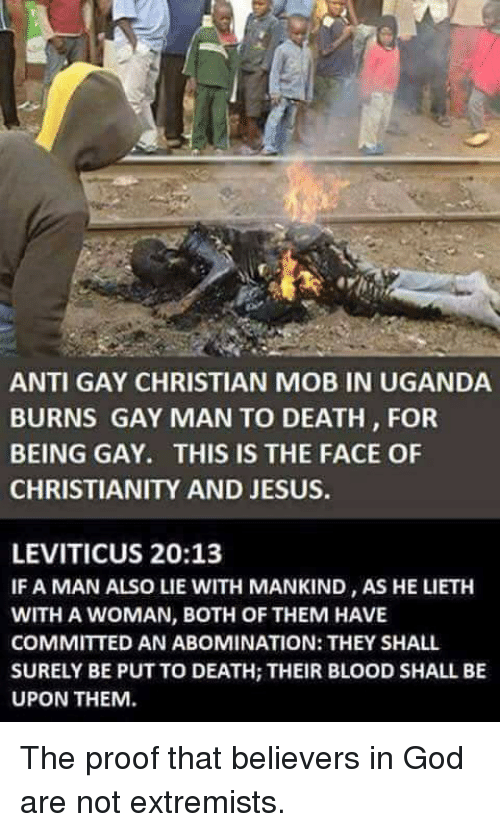
Historically ignorant. That’s really what this meme amounts to. Being anti-gay has nothing to do with religion. Yes, religion can be used as something to hide behind when someone promotes intolerance, but take away religion, and you’d just find a different justification. Because we aren’t talking about religion here, but about culture as a whole.
There are a lot of issues here though. First, Leviticus 20:13 has nothing to do with Christians. I have another video that dives into Leviticus, which I will put in the description below. More so, the means of death as prescribed in Leviticus is stoning to death, not burning to death. Also, Leviticus is talking about an act, which is male anal intercourse. Being gay in and of itself wouldn’t be a cause for death.
So the condemnation isn’t really from the Bible, but is more because homosexuals are a minority, and minorities in general have been persecuted. They are seen as different, and thus aren’t part of “us.”
Interesting little note. Within the Tanakh, or the Jewish Old Testament, this verse is Hosea 14:1 instead.
Anyway, God isn’t the speaker here, it is Hosea. And yes, it’s barbaric. It’s a sad historical fact, and this sort of act pops up in a number of places within the Old Testament.
It really only becomes a problem though if you take the Bible as one hundred percent the literal word of God. That everything in it is the word of God. If we step away from that, as most Christians do, then we can reflect on the passage as something that was part of the historical record of the Hebrews. It’s a sad part of their history, as it is a sad part of the history of many ancient peoples.
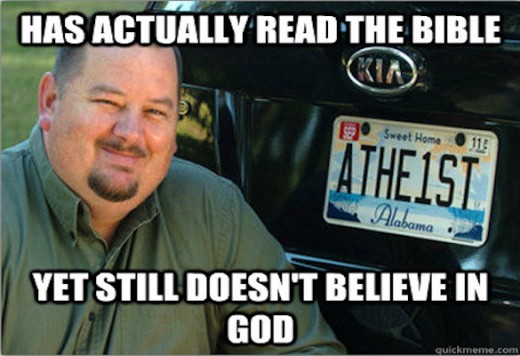
I detest this meme because I was that guy who read the Bible and was still an atheist. I was a fanatical atheist who just pushed it any time I could. I’ve since long grew out of that, but looking back, I was a pompous ass while I was an atheist because I went to an extreme.
Now, I’m a theist. The Bible isn’t why I believe though, and I don’t know many who believe simply because of the Bible. The Bible generally comes later.
My biggest issue with this sort of meme is that the idea simply is a false one. Reading the Bible doesn’t mean much. Going to Sunday school or church doesn’t mean much. It’s some weird sort of claim to authority.
The big problem with the idea is that reading the Bible doesn’t mean you understand it. I think I’ve shown that in the various scriptural memes I’ve discussed so far. There often is a lot more there than just a surface level reading. Part of that is that we often miss a historical context when reading the text, and that context can make a huge difference.
There are also a number of different literary tools in which various Biblical writers are using, and even the different genres they are writing in lends a lot to the work. Some of the most misunderstood works in the Bible are the Epistles of Paul. People often don’t understand that they are letters, and we only have one side of the correspondence. The letters Paul wrote were in response to letters and other correspondence that he received, so Paul is just answering questions that are coming up. He’s not out there developing theology or writing down everything he knows, but he’s answering questions.
If something like that isn’t understood, then reading the writings of Paul becomes convoluted and misunderstood.
Just to begin, there is no book called Corinthians. There is First Corinthians or Second Corinthians. This passage is in First Corinthians. The passage begins with the words, For it is written, which was a standard Jewish practice for citing Jewish Scripture. That’s important to realize as there is a reason why Paul is citing scripture.
Here, Paul is citing Isaiah 29:14. Before jumping into the verse though, the translation that the meme is using simply isn’t the best. A better translation is: I will destroy the wisdom of the wise, and the discernment of the discerning I will thwart.
So we have to take this passage in context, both within First Corinthians and with what is said in Isaiah. The whole thing comes back to a promise from God that God would rescue Israel despite the fact that there has been false consul by the wise.
This is part of a larger rhetoric that Paul is engaging in, where he speaks of God’s foolishness being wiser than human wisdom.
So this has nothing to do with destroying human wisdom, but it’s about destroying false wisdom pushed by false consul.
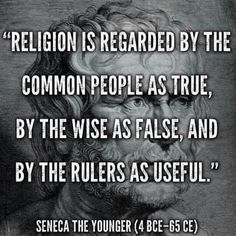
This meme comes up quite a bit. This is one of my least favorite types of memes, as it really is an appeal to authority, and more often than not, the quotation is inaccurate. This quote is most likely inaccurate, as in Seneca never said it. Looking through Seneca’s works, it just isn’t there.
The difficult thing with trying to nail this quote down though is that it has been repeated thousands of times, and doing a quick search brings up hundreds of “quote” websites that never cite where the quote came from. However, uncovering the source isn’t impossible.
The first mention of this quote, that I can find comes around 1903, at earliest. It can be found in the book “Little Journeys: To the home of great philosophers” by Elbert Hubbard. There is no citation there. The quotation is also a bit different as wise is changed to philosopher, and the tense is past, instead of present.
That isn’t where the quote most likely began though. Instead, it most likely originated with Edward Gibbon in his “The History of the Decline and Fall of the Roman Empire,” which was fully completed in 1789. The relevant section states:
“The policy of the emperors and the senate, as far as it concerned religion, was happily seconded by the reflections of the enlightened, and by the habits of the superstitious, part of their subjects. The various modes of worship which prevailed in the Roman world were all considered by the people as equally true; by the philosopher as equally false; and by the magistrate as equally useful. And thus toleration produced not only mutual indulgence, but even religious concord.”
Basically, Gibbon was writing about the views of the Romans, and later on someone simplified it and placed it on the lips of Seneca in order to give it more authority. It also have to be noted that Gibbons was quite hostile to religion, and his biases often cloud the history he was purporting to record.
The quote from Gibbons is part of his wider narrative that saw paganism as tolerant, and Christianity as intolerant. He would largely blame Christianity for the decline of Rome. We can see this idea in this particular quote. He’s not talking about religion but modes of worship, and he’s largely talking about paganism here as that is what really prevailed in the Roman world. He then tries to skirt the issue of how there were persecutions of Christians by saying that the Roman leaders just found these modes of worship useful, instead of acknowledging that the Roman leaders also became passionate believers as well.
So to sum up, the quote isn’t from Seneca, but instead from Gibbons. Gibbons allowed his biases to really guide his history, and the quote really is more of an attack than anything else.
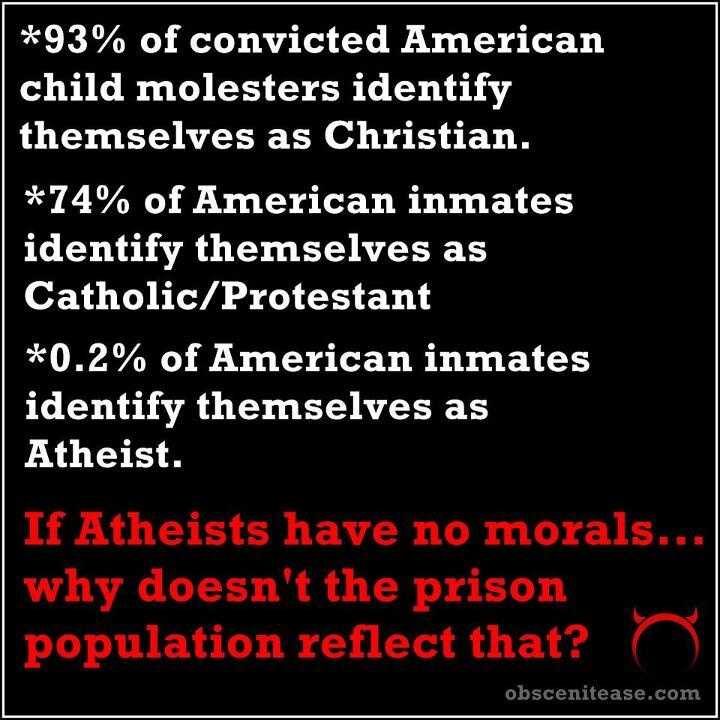
This really is just misunderstanding statistics. I won’t argue with the percentages, because whether they are correct or not doesn’t really matter. The problem is that if we are simply thinking of this logically, of course Christians are going to have higher percentages in these areas because the majority of the population identify as Christian. Atheists, on the other hand, will have low percentages here because they are a small minority of the population.
Really, this is exactly what one would suspect based on population statistics. The majority group will have a higher percent of many things simply because they are the majority. The argument that the meme makes then is fallacious as it’s not taking things into context.
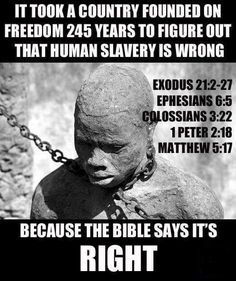
This is one of my least favorite types of memes, as it is so historically inaccurate. The assumption here is one that is baseless, as people didn’t need the Bible to justify slavery. Nor did the United States create slavery. It was an institution they inherited. The fact of the matter is that slavery was a worldwide phenomenon, and it didn’t need any religion to support it.
Slavery simply didn’t need any justification in the United States as it was a part of life. Slavery just was. When justification eventually was needed, it wasn’t the Bible people turned to, but towards economy and racism. White people weren’t suited to work in the fields in the sweltering heat. Religion wasn’t needed.
On the flip side, religion wasn’t needed to defeat slavery either. A great example is Abraham Lincoln and his fight against slavery. He didn’t need religion to tell him that people are equal, and that slavery was a travesty.
Here’s the clincher though. The Bible wasn’t used to defend slavery until after it was being used by abolitionists in order to demonize slavery. And when those who were pro-slavery decided to use it, they cited the weirdest example; the Curse of Ham. I will go into the Curse of Ham in more detail later on, but quickly, the Curse of Ham goes back to an incident with Abraham. Ham walks in on his father, Abraham, as he was passed out naked. Ham tells his brothers, who walk in backwards and drops a covering over Abraham. Abraham wakes up, gets pissed, and curses Ham, saying he will be ruled over by his brothers. The pro-slavery group claimed that the descendants of Ham were Africans, and thus it was okay to enslave them. Yeah, so quite weird.
To sum up then, the Bible really had little to do with slavery in the United States. It wasn’t needed to justify it, and it wasn’t until after the abolitionists started using it to demonize slavery, that the pro-slave crowd started using it. But even then, it wasn’t the biggest justification.
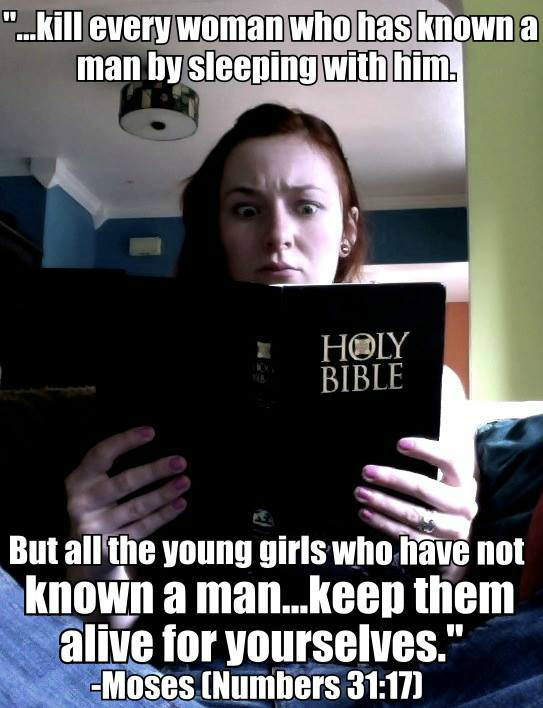
This is one of the go to passages among some atheists when they want to show how despicable God is, and how the Bible is evil. To be clear, the passage is a doozy. To try to justify the passage really is a pointless endeavor.
A quick point though. This passage is attributed to Moses, as the meme correctly points out. It is not a command of God, but one of a political leader.
To understand the passage though, we need to know the historical context. What Moses is commanding here is really a common military tactic of the time in the ancient Near East. Sadly, it’s one of those times in which the ancient Israelites just did not overcome their historical context.
The practice makes some sort of military sense though. When thinking of the ancient Near East, we are talking, often, about a lot of smaller tribes who are connected to other tribes. Conquering one tribe didn’t conquer all of the people, so the threat was still there. To counter this threat, conquering tribes would massacre the group the defeated in order to limit the possibility of a future attack.
That doesn’t justify the practice, but it does put it into a historical context. As for the final portion, it’s actually verse 18, and a better translation would be, “And all the little ones of the women who have not known lying with a male, let live.” It’s an odd phrasing, but the Hebrew itself is just as odd. This translation does take some of the bite out of the verse, but the implication is still there.
The reason they are allowed to live is because they could then be married into the Israelites, and then produce Israelite babies, which furthered the growth of the tribe. Again, not a justification, just a clarification of the historical context.
So yes, a doozy of a passage, but there is also a lot more to it. As a whole, the passage isn’t a problem unless one takes a very strict stance on the Bible. Such a position though really is a minority view.
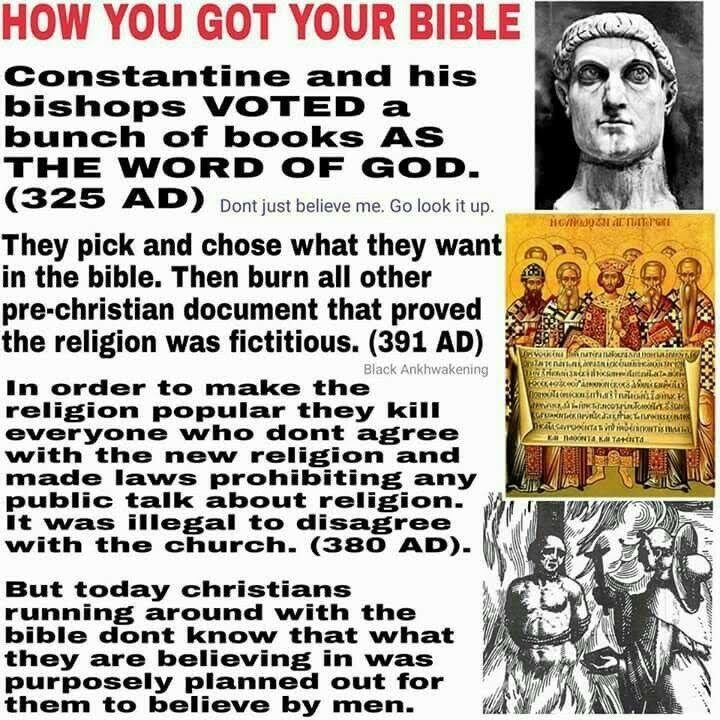
It’s the old Constantine myth. There has been a mass of misinformation about Constantine, and the Council of Nicaea. This was something that figures such as Dan Brown (the author of the Da Vinci Code) have really capitalized on, which has propelled such myths into the mainstream.
However, the actual accounts of the Council of Nicaea are quite different.
In the grand scheme of things, Constantine had pretty much nothing to do with the Council of Nicaea. That is besides calling it to order. Constantine had little to no grasp over the theological issues that were at stake. Nor was he a theologian, or a scholar. Some would even debate whether or not he was a Christian at all as he wouldn’t be baptized until much later.
What he did do was allow the Bishops to debate these issues and come to some sort of agreement (even though that agreement really didn’t settle anything). And in the end, he really didn’t care what view of Christ’s nature won out, as long as they came to some sort of agreement for unity sake.
A bit of background would be helpful. In 313 AD, Constantine made it possible for Christians to practice their religion openly through the Edict of Milan. The Edict wasn’t just focused on Christians, but opened up religious tolerance in general.
Christianity was still just a small portion of the Roman Empire, but it was one that was growing considerably. However, it was a fractured religion. Constantine was looking to unify his empire in general, and having a unified Christianity would help with that task.
The big division within Christianity in the 4th century surrounded a controversy regarding the nature of Jesus, and specifically how Jesus related to God. There were too main views, Arianism, which was view of Arius of Alexandria, and homoousian, meaning same in being.
Arianism claimed that Jesus was divine, but he was not equal to God, as Jesus was still a created being. Homoousian instead declared that Jesus and God are in fact equal, that they were of one substance, and coeternal.
The Council of Nicaea wouldn’t be the first time that this difference would be debated though. In 320/321 AD, the Bishop of Alexandria, St. Alexander, called over 100 Bishops from Egypt and Libya together, and they condemned Arianism. But it really didn’t stop Arius from continuing to preach and recruiting new members to his view. He would be banished from Egypt, but just continued to travel elsewhere.
This was a major controversy within Christianity, and would garner the attention of Constantine, who wrote letters to both Arius and St. Alexander, telling them that they needed to reconcile. The Council was just the next step.
Interesting enough, Constantine would be limited with his interactions with the council because he spoke a different language. The language of Rome, and Constantine, was Latin. But the language of Christianity was largely Greek. Because of that, Constantine, when addressing the council, had to use an interpreter.
The second myth actually is linked to the first. The idea is that the Council of Nicaea created a unified Christianity, or in other words, defined Christianity. Now, this may be true on paper, but in actual discussion, it really changed nothing. Debate continued for decades, and the same positions were still held afterward. The main change was that on paper, there was an accepted idea.
Arius would be deemed a heretic, and the Emperor exiled him, to Illyria, which was in the western part of the Balkan Peninsula. Instead, Arius would take refuge in Palestine, and eventually, Constantine allowed him to return, with the concession that Arius played down the ideas that his critics found most objectionable. This didn’t go over very well with his critics, and it is probable that one of his opponents poisoned him.
However, that wasn’t the end of Arianism. After Constantine died, Constantius II took over, and was an Arian sympathizer. In 357, the Third Council of Sirmium produced the Seventh Arian Confession (or Second Sirmium Confession) which basically said that Arius was right. The confession would then be dropped, and it is now known as the Blasphemy of Sirmium.
So not much changed from a practical stance, but on paper, there was now a more unified view of Christianity.
So where does the Bible fit in? It fits in as almost a footnote as the Bible wasn’t really discussed. Constantine did have 50 Bibles commissioned to be made, but it wasn’t something that needed to be discussed as the canon was virtually set by that time.
The Tanakh, or the Christian Old Testament, was finished by the time Jesus was born. The Septuagint, which was the Greek translation of the Old Testament, which Christians then inherited, was completed by the second century BC. Constantine and Christians in general really didn’t have anything to do with it.
As for the New Testament, the first canon began in the second century AD. This was created by Marcion of Sinope. He included 10 epistles of St. Paul, as well as a version of the Gospel of Luke. It wouldn’t be long after that that the proto-orthodox Church would then start forming a canon.
Also in the second century, a four Gospel canon was also being promoted by Irenaeus. By the early third century, we have Origen of Alexandria who seems to be using a similar canon to the 27 books we have now. But by the middle of the 3rd century, the canon was pretty much set up. This is nearly a century before the Council of Nicaea.
Just a quick note. In 391, the Emperor Theodosius issued a few decrees that effectively banned paganism. However, that had nothing to do with burning pre-Christian documents that proved the religion fictitious. What possible documents those would be, I have no idea anyway, as pre-Christian documents simply didn’t talk about a faith that hadn’t been created.
In 380, there was persecution conducted on behalf of the Catholic Church. That really has nothing to do with getting the Bible though, so I’m not really sure why it is thrown into the meme.
When it comes down to it, the Bible was largely formed before Constantine, and the fact that later on, Christians persecuted others really has nothing to do with the Bible. It’s a great topic for another time, but is irrelevant to the Bible.