At what point do you just give up? Because at times, life just continually beats you down. Any highs are instantly followed by multiple downs, so moving forward never seems possible. And just as you see some light, the rug is pulled out from under you. As that light diminishes, the option of giving up can often be appealing. So why not?
Over the last few years, one thing that has often thrown my life into chaos is health issues. Just as our son was finishing his treatment for cancer, I was hit with a sack of bricks: I have a congenital heart defect that has considerable worry. Still in my early 30s, I had had multiple heart attacks, had went into cardiac arrest and was clinically dead for a short while, and with all of this, have a host of other health issues. Which is on top of other issues, such as having Crohn’s and autism, as well as issues with my spine.
The last week or so, these issues have been often at the forefront of my thoughts. While progress has been made health wise, constant complications have also arisen. The last couple of weeks have seen a number of these complications, which are often incredibly frustrating, as they always seem like a step back.
Having chronic health issues also leads to other issues though. For some, it’s depression. Others, it’s drug addiction, as it’s the only escape they can find. And then there is suicide, because for some, that’s the only escape they can imagine. Yet, there are those who overcome all these issues; giving up just isn’t an option.
To be honest, the idea of giving up has briefly crossed my mind in the past. What that exactly entails, I’m not quite sure as it’s not an idea that I have ever really entertained. So what differentiates those who don’t entertain the idea, and those who do eventual succumb to it?
Such a question always reminds me of Viktor Frankl’s book, Man’s Search for Meaning. Frankl was a psychiatrist who survived the horrors of the Holocaust. After being liberated from a concentration camp, he founded a school of psychiatry called logotheraphy, which described man’s search for meaning to be a primary motivational force. Part of this idea rested on his observations within the concentration camp that those who had a reason to live, a meaning to their life, had a better chance of surviving. Those who had no reason to live, those who succumbed to giving up hope, tended to perish quickly.
What that meaning was didn’t necessarily matter. The fact that they had a meaning drove them to push ahead. It gave them a reason to fight for survival. Granted, this didn’t mean they necessarily would survive, but it meant they continued trying to make it through, regardless of the hardships they encountered.
I first read the book about a decade ago. Over the years, I’ve come back to it from time to time as the message is so moving. It’s a message I think many could do well to hear. As having some meaning to one’s life, whether it be family, or a manuscript you want to finish, as Frankl had, can make a huge difference. For me, I think it’s the primary reason that there just isn’t a point where giving up seems reasonable.
The idea that we control our destinies, that we have the power to pull ourselves up by our boot straps can often be comforting. If we only work hard enough, we will succeed. However, reality is often different, because the actions of others can have massive repercussions.
This past summer, my wife and I helped out an individual who would end up costing us greatly. A few simple rules were set up, and because this individual refused to abide by them, multiple reports were filed that someone was “living” or “staying” behind our store, in the parking lot, in dangerous conditions due to the temperature. Our insurance company would find out, and because we were “seemingly doing nothing to rectify the situation,” we were found to be in breach of contract.
Time and time again, I attempted to speak with this individual, and come to an understanding, while making sure they were aware of the damage they were doing, but it was to no avail. Even though we had set out to help this individual, in their mind, we were the ones in the wrong.
The ramifications of this have been ongoing. It would first result in higher premiums, and then extra fees. We then had to change our coverage, which would prevent us from doing a number of things we wanted to with the business, costing us potential earnings. And then because we have a breach of contract on our record, it has cost us other opportunities.
Honestly though, we probably should have known that helping this individual would have caused issues. Over the last few years, their actions, or refusal to actually do anything, had cost us countless opportunities, while at the same time costing us financially. And most recently, it cost me an opportunity to receive some great tools. It turns out that I’m on a blacklist as I had recommended this individual for a review tool a couple years back, and because they ignored this companies phone calls, and emails, I was deemed unreliable. Which caught back up to me recently.
Now, maybe part of it was our fault. Having been burned before, we should have known better. But then again, who wants to live their lives thinking that helping someone will end up hurting you? At some point though, one has to learn their lesson, and the lesson for us is that you can only help someone so much before it becomes ridiculous to help them any further. If that person doesn’t want to help themselves, then trying to help them will achieve very little.
Forgiving that person will also become necessary at some point. Not for them, but for us, as hanging onto the hurt and anger does us no good. It just causes more stress on us. That’s not to say that forgetting what they have done is a good idea though. As forgetting such just sets us up for additional problems in the future.
Most importantly, we can’t allow the actions of this one individual taint how we see the world, or how we respond to others who may need help. It is very easy to become cynical, and see the worse in others because of the actions of a few. But trying to overcome that, and seeing that people are still truly good, is something I believe is worth striving for.
I support Israel. Well, kind of. The truth of the matter, and most matters in general, is that the Israeli-Palestinian conflict is much more complicated than it is often portrayed. And to really delve into that complication, we have to place it into its proper historical context.
That historical context is vast though. It also encompasses an incredibly misunderstood portion of human history; WWII and specifically the Holocaust. Regretfully, the distance between us today, and that horrific past has done us no favors, with the motto of “Never Forget” changing to “just get over it,” or “that’s distant history, you just have to move past it.” Yet, even today, the Jewish population has never recovered.
Even more so, Judaism, the religion of Jews, and a key component of their culture, was forever, and fundamentally, changed due to the philosophical implications of the Holocaust. Beyond that, even after the Holocaust was over, it wasn’t really over.
By placing this entire conflict into perspective, and placing Jewish history into context, what we see is that while the war was won, the anti-Semitism, and the genocide continued, with Nazis continuing to stay in power, and with Jews being slaughtered.
But before we even get to the Holocaust, and finally the creation of the state of Israel, we need to go even further back.
The Jewish Question
The history of the Jewish people is one largely of subjugation and expulsion. Historically, Hebrews, and later Jews, never had significant power. While there would be a short lived United Monarchy, followed by the two kingdoms of Israel and Judah, these nations would never be of major strength. For the most part, they would be a footnote in history, with their largest importance really being a buffer zone.
During their short lived period of sovereignty, they would face constant threats, such as by the Egyptians, and later, domination at the hands of the Assyrians and Babylonians. They would also face exile and deportation. While some inroads would be made back into Palestine, later expulsions would center the Jewish community in Europe.
During the Middle Ages, the core of the Jewish community was centered in Europe, but that didn’t stop the expulsions. Throughout Europe, they would continue to face expulsions from places such as England, and Spain, as well as pogroms throughout the Russian Empire, not to mention the massacres and anti-Semitism that would occur throughout the continent.
Now, there is a lot of history here, which would take volumes to cover. The key point though is that the Jewish community had a history of being expelled, of being persecuted and having to relocate. While peace, or at least periods of less hardship could be found, much of the history is filled with persecution. For our purposes, we can jump to around 1753, with the coining of the term, the “Jewish Question.”
The Jewish Question was first posed in Great Britain in regards to debates surrounding the Jewish Naturalization Act of 1753. Briefly, the Jewish Naturalization Act would have allowed Jews to become naturalized citizens of Great Britain, and was largely a reward for the loyalty to the government that the Jewish community had shown during the Jacobite rising of 1745.
The Bill was quickly rescinded though after an enormous public outburst of anti-Semitism broke out. Over the course of almost two centuries, the question would crop up time and time again when dealing with Jews, who seemed to pose a singularity as a people, against a growing trend to nationalism among various states.
Various solutions to this question would be posed by different governments, ranging from expulsion, to widespread pogroms and ethnic cleansing, especially in Eastern Europe, to segregation, such as forcing Jews to only live in what would become known as the Pale of Settlement in the Russian Empire.
This increased persecution, and the rise of anti-Semitism in general, led many in the Jewish community to try to find a solution themselves. This would give birth to organizations such as the Jewish Colonization Association, which helped Jews flee Europe by setting up colonies where they could, including in South America and Palestine. It would also give rise to the modern Zionist movement in the mid and late 1800s.
On the other hand, at the same time that Zionism was being formed, Arab and Palestinian Nationalism were also rising in popularity. This rising nationalism would form a foundation for the later Israeli-Palestinian conflict.
While Jews had lived in Palestine for generations, the rise of both Zionism and Arab Nationalism made for an incredibly shaky relationship. Zionism was seen as a threat among the Arab leaders in Palestine, and with a growing influx of Jews into Palestine, that threat was met with violence.
This would only worsen with Germany’s solutions to the Jewish Question. With the situation worsening in Europe, the demand for Jewish immigration had grown considerably. It would be met with an increasing difficulty though. Places, which were once safe havens, such as the United States, Brazil and Argentina, were restricting passage for Jews fleeing from Europe. This would lead to Jews instead fleeing to the Middle East, including Palestine, in much larger numbers.
The mass exodus of Jews from Europe also coincided with the initial solution that Nazi Germany had for the Jewish Question. Deportation was a central idea, to begin with. But as Germany’s goals increased, for them, it became clear what the answer was to this Jewish Question. They developed the Final Solution.
Genocide
Often, when we think of the Holocaust, and the acts of Nazi Germany, we want to see it as an isolated event. That what the Nazis did existed in a bubble. The truth is much less clean and tidy. What the Nazis did, what the Holocaust symbolized, was just the next step in an evolutionary process. The Nazis were able to achieve, at least in part, what others had already attempted. What made the Nazis stand out, and allowed for the Holocaust, was the industrialization of the killing process.
Ethnic cleansing of Jews was widespread. Russia led this sort of atrocity, but Eastern Europe in general was guilty of such actions. In places like Poland, pogroms grew to be more regular, which increased the mass exoduses from those areas.
With the rise of the Nazi party, and the development of the Final Solution, those ethnic cleansings, and atrocities, were conducted on a much larger scale. And this time, they were done with an efficiency that had never been seen before. Genocide was turned into a science, and Germany had everything it needed to conduct it on a mass scale.
While the Holocaust would begin in Europe, Hitler’s intention was to fully exterminate the Jewish population. In 1941, Hitler met with Amin al-Husayni, a Muslim leader in Mandatory Palestine, and promised that Germany would also eliminate the Jewish foundations in Palestine.
During WWII, Jews in Palestine were surrounded by pro-Nazi regimes. Arab leadership in Palestine had made ties with the Nazi Party as far back as 1936, and the Vichy regime in control of Syria and Lebanon were both pro-Nazi. This would lead to two major fears of German invasion into Palestine.
The first was from the north, with the Vichy regime, but was squashed by the allied invasion on June 8, 1941. The more serious threat has become known as the 200 days of dread.
In 1942, the German Afrika Korps, under the command of Erwin Rommel, was posed to overrun British possessions in the Middle East. As part of the invasion, Einsatzgruppe Egypt had been commanded to carry out systematic mass killings of Jews in both Palestine and Egypt.
The 200 days of dread would eventually come to an end after the Allied victory in the Second Battle of El Alamein, which halted the Axis from advancing further into Egypt.
By the end of the war, it’s estimated that 6 million Jews had been murdered. That’s around 60% of the Jewish population in Europe. Even as the Allies closed in on the Nazis, and on Hitler, the slaughtering of Jews did not cease. If the Nazis were going to lose the war, they were going to still kill as many Jews as humanly possible.
After the War
For many of us, we imagine that once the Allies liberated the Concentration and Death camps, Jews were free to go home in peace. The truth couldn’t be further from that depiction.
In Poland, as Jews attempted to return, anti-Jewish riots broke out in numerous cities. In Kielce, during July 1946, 150 Jews tried to return home. Fearing that hundreds more would return to reclaim their belongings and property, a pogrom broke out. 41 Jews would be killed, and 50 more wounded. It was clear that returning home wasn’t an option.
Many Jews would remain in their concentration camps, which had been turned into displaced persons’ camps. There they would wait until they could find a new country to call home, but much of the world didn’t want them. And to add insult to injury, in many of these camps, it was the Nazi soldiers who were often put in control over the populations.
While we would like to think that after the war, the Germans realized their mistakes and tried to change them, the fact is that little really changed. The Germans knew of the severity of their crimes against humanity, so much so that when the liberating armies were approaching, they attempted to destroy as much evidence as possible.
Today, when visiting Germany, few depictions, statues, and forms of honoring of the Nazis remain. However, this wasn’t by choice for the Germans; it was forced upon them, a condition of their defeat. The country would have a superficial face lift, erasing the crimes of their past. But when it came to the inner structure, things continued as they had.
Few Nazis would be tried and convicted of their crimes. Even if they had been brought before the country’s judges, it wouldn’t have matter as many of those judges were Nazis themselves. The rampant anti-Semitism continued to exist as it had before, and throughout Europe, it was clear that there was no safe refugee.
For years, these Holocaust survivors were stuck in these camps where they had seen so much death and destruction. There was no place to go as no one would have them. Hundreds of thousands of Jews, who had been rounded up to be slaughtered, were now stuck in limbo. This limbo would last for many of them until 1948.
Finding a Home
While Jewish colonies had been set up around the world prior to WWII, growing anti-Semitism made virtually all of them unsuitable. Mass exoduses to South America among the Jews had produced a number of flourishing communities in places like Argentina and Brazil, as the War approached, the area became increasingly less hospitable. And after Germany’s defeat, these countries would become safe havens for Nazis fleeing Europe.
Even in the United States, where Jewish communities now thrive, it would take years after the war for them to open their borders to receive these displaced Jews. Sadly, before the United States would open their doors to Jews who survived the Holocaust, they had already been welcoming Nazis they deemed important, giving them a new home.
With the tragedy that had just fallen upon them, centralizing Jews into a stronger area, an area they could be unified and have some control over, became much more important. The United States was an option, once it opened up, but for many it wouldn’t be enough, as the country could always turn on them. And Jews knew the ramifications of that.
Palestine became the leading solution for many Jews; really the only plausible solution. While Palestine was their ancestral home, it also had a sizeable Jewish community. It was also part of the now defunct Ottoman Empire, and was a League of Nations mandate, which became a United Nations mandate.
Part of Mandatory Palestine was the Balfour Declaration of 1917, in which the British had promised support of a Jewish national home. Because of that, discussions about establishing a homeland for Jews had been discussed for decades leading up to the 1947 partition. In a special session, the UN General Assembly voted to partition Palestine into two states; one Jewish, one Arab.
Virtually as soon as the Resolution had been approved, attacks were performed by Arab irregulars against the Jewish population of Palestine. Reprisals, and counter-reprisals would continue, with thousands being wounded or killed.
When the termination of the British mandate ended, and Israel declared Independence, an all out war broke out. It would become known as the First Arab-Israeli War, which erupted on May 14, 1948. During the next couple of days, Jordan, Syria, Egypt and Iraq, followed later by Lebanon, would join the Palestinians.
The purpose of the Arab armies was largely the same as what Hitler proposed; extermination. For the Jews, fearing another Holocaust, their initial goal was survival. They had anticipated an Arab invasion, and hoped that their preparations would be enough to prevent annihilation.
That goal would later expand to expanding the Jewish state beyond the borders assigned by the UN partition agreement, in order to both incorporate isolated Jewish communities, but also add more territories to their state in a way that would give them easier to defend borders.
The war waged on for 10 months, and after it was over, around 750,000 Palestinian Arabs would be expelled, or had fled, the area. At the same time, about 850,000 Jews were expelled, or fled their homes in Arab countries. Many of these individuals would be able to find a home in Israel, but hundreds of thousands would have to find a new home elsewhere.
For those Palestinian Arabs, their situation was much more tragic. Most remain refugees, and continue to live in refugee camps. Neighboring Arab states would deny them, or their descendants, citizenship. In 1949, Israel did try to offer a partial solution, by allowing some, who had families in Israel, to return home, to release refugee accounts, and to repatriate 100,000 refugees, but the Arab states rejected any sort of compromise. As far as they were concerned, Israel didn’t exist, and thus they would not do anything that might give them recognition as a state.
Those Arabs who had remained in Israel would eventually be granted citizenship, and finally the same rights as Jewish citizens, but it was a long road.
Continued War
For nearly two more decades, conflict would continue, with violence being instigated on both sides. The major threat to Israel though would be Egypt.
Having gained control of the Gaza Strip, during the previous war, Egypt aided Palestinian attacks from that area. They would also begin amassing a large troop on the Sinai Peninsula. With the threat increasing not only from Egypt, but other neighboring states, Israel launched a preemptive strike that would result in the Six-Day War.
Following the war, Israel had succeeded in claiming the entire area that was once the British mandate of Palestine. It also led the Arab nations to form the “three no’s;” no recognition, no peace, no negotiation with Israel.
There would also become an increase in the activity of the Palestinian Liberation Organization, the PLO. Founded in 1964, a primary goal of theirs was to establish a Palestinian state within the entire area that was under the British mandate, as well as to purge Zionists from Palestine.
The PLO would be founded in armed struggle, believing that it would be through force that their goals would be accomplished. However, since 1993, they have now recognized the right of Israel to exist, and have officially rejected violence and terrorism. Terrorism did continue, and in 2018, a segment of the PLO has once again called for the destruction of Israel, rejecting their right to exist.
However, for two and a half decades, the PLO would wage a terrorist campaign against Israel. This campaign would also be fueled by the Soviet Union, both through training PLO members on covert bombings and plane hijackings, as well as by releasing propaganda, such as the The Protocols of the Elders of Zion in Arabic, to help fan the flames of discontent.
In this environment, two more wars would be fought. The Yum Kippur War, initiated by Syria and Egypt, as well as the 1982 Lebanon War, initiated by Israel against the PLO who were stationed there.
Attempt at Peace
Multiple attempts at peace would be had, with one of the most promising being the Oslo Peace Process. Both the PLO and Israel agreed to work towards a two-state solution, but negotiations would fail. From 1993-2000, talks would occur even though attacks were being conducted by both sides of the conflict.
In July of 2000, the talks would finally come to an end, after Yasser Arafat, the PLO leader, rejected a possible agreement, without making a counter-offer. Peace talks would halt, as violence was rising.
A new uprising broke up, which continues even now. Increased terror attacks against Israeli civilians led to Israeli troops to begin conducting more regular raids and arrests. Multiple attempts at peace would be made during this time period, with even the Arab League trying to find a suitable solution.
However, with steps forward, drawbacks continue to be had. In 2002, the West Bank barrier was constructed, which helped reduce suicide bombings and other attacks across Israel by 90%. But the barrier has also been met with serious issues, as much of it was built within Palestinian territory, as per the 1948 Green Line. Right-wing and ultra-conservative groups within Israel have also objected to many of the peace solutions.
The death of Yasser Arafat also provided a major blow. Upon his death, it was revealed that he had received billions of dollars in aid from both foreign nations and other organizations, but much of this money was never used to develop Palestinian society. On a yearly basis they were receiving almost 2 billion dollars, with close to 10 million in total assets.
This controversy eroded much of the remaining faith that Palestinians had in the organization, and it gave the Hamas a growing support, who did not recognize Israel’s right to exist.
In turn, this led Israel to cut off negotiations with the Palestinian Authority, which was controlled by the Hamas, as they couldn’t negotiate with an organization that was intent on wiping them out.
The Situation Today
The current situation in Israel is multi-faceted, and surrounded by difficult history. To put the blame on one side ignores all that history. To pretend that the situation is an easy solution ignores all that history.
For half a century, Israel has faced threats not only to their existence, but attacks on their citizens from people who refuse to recognize their right to exist. In turn, they have aggressively defended themselves, because they know what happens when they don’t. Their need for sovereignty, for them, is a matter of life and death, which the Holocaust made very real for them.
With the Palestinians, hundreds of thousands were expelled or had to flee from their homelands. Some of those exoduses were fueled by the promise that they would be able to return home after the Jewish presence was eradicated. But today, that has left many of those individuals as refugees. However, we also can’t ignore that those countries that supposedly came to assist them then also left them without any support when they lost, and sabotaged potential help from Israel because of their refusal to accept their right to exist.
For those Palestinians who have remained, they also face the threat of their lands being encroached on, as mass influxes of Jews into the country has led many looking for areas to expand. While Israel, at times, has tried to restrict this encroachment, they simply haven’t succeeded.
Today, by far, Israel is the stronger force there. They were a nation forged in war, formed in horrors, that they don’t want to repeat. It makes for a mighty nation, but not one that is always fair or kind. Palestine, on the other hand, has a legitimate reason to be angry. They had promises made to them, which in part led to hundreds of thousands becoming refugees and their lands taken. Those who would lead them have done so through violence, and often terrorism, thinking it’s the only option. Which only continues the cycle of violence.
Neither side is innocent, but neither side is fully to blame either. It’s a complicated situation, that needs nuance. And that nuance has to be rooted in some historical knowledge.
After the Civil War, a shift in how the country perceived itself began to quicken. The way citizens of the United States saw themselves was changing. To whom we were loyal was broadening outside of our own states.
The country went from saying, “the United States are,” to “the United States is.” While the country had been torn asunder just a few years prior, having created a divided house that did collapse, it was moving forward as a singular entity. It was more than just a healing process that occurred after the war, but a complete transformation that sought to unify the states into one.
Now, this transformation didn’t instantaneously occur. For decades afterwards, official government records and organizations would continue, in part, using a plural form of the United States, that the United States are. But for the general public, it was much different. They embraced the change, which was already beginning to take hold prior to the Civil War.
Popular works, including books and pamphlets of the time, as well as newspapers, started speaking about us as one, a singular entity. So effective would this shift be that today, we simply take it for granted.
However, while we may view ourselves as a singular country, a different divide has begun to manifest. As with the Civil War, and the separation of the country, the question again is to whom is our loyalty given?
The Question of Loyalty
One of the misunderstandings that many have about the Civil War is exactly why it was fought, but even more, why individuals chose to fight. The reason why a state seceded, and why a citizen of that state would fight was often quite different.
At the most basic level, those southern states that chose to secede did so, at least in part, because they wanted to see the institution of slavery remain. When looking at the articles of secession by each state, saving slavery is explicitly mentioned. Even before Abraham Lincoln was elected President, there were threats by various states that if a Republican won the election, they would leave the union because of the potential threat to slavery.
History is very clear that slavery was a major factor as to why southern states seceded. However, history is also quite clear that the reason someone would choose to become a traitor, and fight for their state against the country they had just abandoned, often had nothing to do with slavery. Instead, their motivation to fight was due to their loyalty to their state. A loyalty that superseded any loyalty they may have had towards the United States.
And let’s be clear, those who chose to secede and fight against the United States committed treason. They gave up their citizenship for a new country, while turning on their former country and attacking it. Over the years, this has been a point often gleamed over. The reason for this is rather simple. After the United States won, after the Union was victorious, the goal was for reunification. To do that, leniency was practiced.
So why did so many choose to commit treason? Largely because their loyalty was for their state. They saw themselves as a citizen of their state first and foremost, and then part of some larger union. The perception was still that the United States was plural, not a singular entity.
Before the Civil War, many had already seen the country as having been divided, not just between north and south, but between states. For decades after the war, the country has tried to fix that. Entire narratives have been invented in order to promote unity and the idea that we are the United States, a singular country. That loyalty to the country comes first.
Regardless of how hard many have tried in order to keep this narrative up, in recent years it has begun crumbling quite quickly. At least among a segment of our population. A segment that exists on both sides of the aisle.
Causing a Division
While at one time, it was state boundaries that caused a massive division, today, it’s colors, or letters, that has become the wedge that is causing the split. What has to be stressed though is that both sides are guilty of hammering that wedge down further.
So what is that matter that is causing this division? Loyalty to either a political party, or at times, a political leader, over loyalty to a county. This became most evident on January 6, 2021, when the Capitol was stormed. As more details have come out about that fateful day, a few things have become clear.
But first, we have to realize that those who committed those acts on January 6 are a minority group. They don’t represent the Republican party as a whole, or even conservatives in general. Instead, they represent a group on an extreme edge. This is important to note as often we mistake the very vocal minority for the majority.
What occurred on January 6 is only the clearest example of this idea of choosing a party, or specifically a leader, over one’s own country. Those who stormed the Capitol, at least in part, were intent on overthrowing a democratically elected official in order to have their own candidate retain power. Some of these individuals were so intent that they sought to kidnap and perhaps even murder those they saw as opposing them.
There is no reason to even conjecture here as to what the intent was among some of these participants, as the investigations into the whole affair have made the intent clear. These individuals were clear about what they wanted to achieve, which was to keep Trump as President, and what lengths they were willing to go to achieve that goal, which included possible murder.
While some Democrats and liberals haven’t gone to that same extreme, at least not yet, the mentality is still the same. For those individuals, it’s party over country. Individuals on both sides are guilty of this, which has to be remembered. It’s not only one side who sees this situation as us vs them. As good vs evil. As moral vs corrupt.
Diversity in our Foundation
Once a person gets to that point, country no longer really matters, because the fact is, the United States is a remarkably diverse nation. It was founded on diversity, on the exchange of opposing views, in which our founders were able to find compromises. The very document in which the United States is built on, the Constitution, is a work of compromises. The Bill of Rights, which so many hold so dear, was a necessary compromise to even get the Constitution ratified.
To get rid of this diversity, as some on either side wish to do, we threaten to undermine the very foundation of this nation. To refuse to compromise, or even to listen to other views, is the exact opposite of how this country was formed. One could say that to do such, is unAmerican.
The United States isn’t just Democrats or Republicans. It’s not one side or the other. It’s so much more complicated, as it should be. The founding of our nation wasn’t a simple process, but one that was exceptionally complicated.
If we can’t even sit down and hear the other side out, we’ve already lost. If we lose respect for a person based on a single vote, we’ve already lost. And if we can’t see the need to compromise, then yes, we’ve lost.
The Fix
There is no easy fix to all of this. It took us decades to get into a position where a group of people would feel justified in storming the Capitol. It won’t be fixed in a single day. It’s going to be something that takes time, and patience.
What it does mean is that we all have to put in a bit of effort. We have to realize that any vote for a candidate is a series of compromises. It’s a balancing act, weighing what one sees as positive, vs that which is negative. It means realizing that voting for someone doesn’t mean you support everything they stand for or may represent.
It also means speaking with those on the other side, and doing so in an open and honest manner. Going into a conversation and believing the other side is evil gets us nowhere. Those biases have to be dropped, and our own prejudices checked.
But most of all, it means accepting diversity. Diversity of political views.
This really is a reason why I detest memes. They really dumb down ideas to an absurd point as the intention is to create a guttural reaction.
What this meme is doing is confusing the idea of the Trinity. Part of the reason why the Trinity is often misunderstood is because so many want to make the claim that it’s a super simple idea, when it’s not. I do have a short introduction video to the Trinity, which I will put in description, and I have a podcast episode of it coming out shortly.
But quickly, the idea of the Trinity does not state that Jesus and God are the exact same person. Jesus is seen as being distinct from God. Jesus is a different facet of God. That’s why Jesus could refer to God as his Father, creating a clear distinction. It’s always why Jesus could still pray to a transcendent God.
It goes further than that as Jesus was also said to be fully human. This is quite different from the divine being of God. There is once again a distinction.
The doctrine of the Trinity doesn’t state that the Father, Son, and Spirit are exactly the same, but they are related.
Yep, I was that pompous jerk. There’s a difference from bringing up the history of Christmas, and pushing it at others as a sign of why Christianity is a joke. I was the latter.
Christmas was never a pagan holiday though. After Christianity grew in numbers, and more people were converting, there arose a need to add some sort of festival to the religion.
Around the winter solstice, there were some festivals already present, and many Christians would still participate in them as it was part of the culture.
To help bring these people more fully into Christianity, Christmas was born and placed around this same time period. It was a way for converts to really connect with their new religion. It was a piece of assimilation, and it worked quite well.
Over the years, Christmas has really changed as Christianity moved to new places, and new cultures were being put into the mix. As those new cultures entered into Christianity, they also brought some old traditions that were mixed into the new ones.
That’s really a simple summation of it. I do have a reaction or response video planned that will dive more into this though.
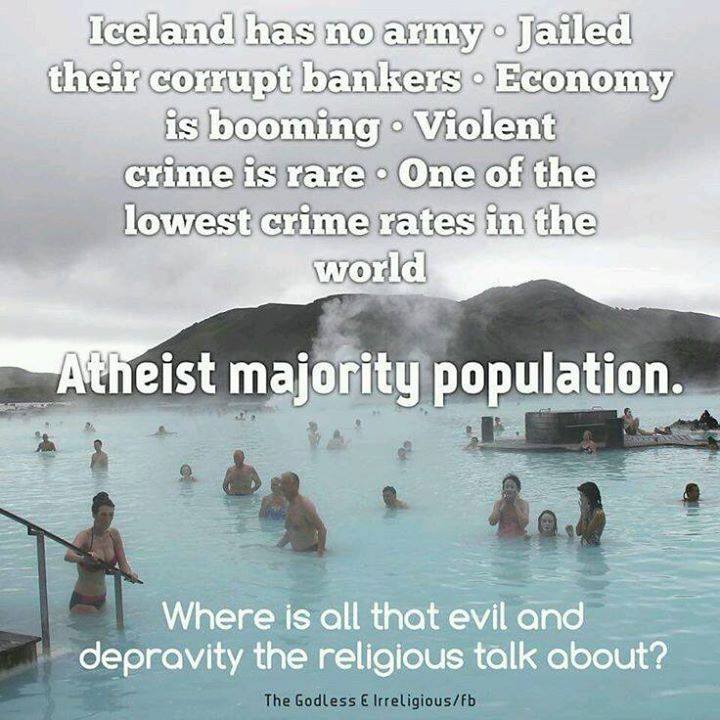
I’m not quite sure where the stats for this meme came from. Iceland doesn’t have a standing army. They did jail some corrupt bankers. Crime rates are among the lowest in the world. There economy is rising. But atheists only make up 10% of the country, while 80% identify as Lutheran.
There currently aren’t any countries that have a majority atheist population. China is the closest with 47% of the population being atheist.
So the foundation of the argument simply doesn’t work as it’s false. There is a bigger issue with the argument though, and that is cherry picking data.
Finding one country that has low crime, is prosperous, is morally good, doesn’t really say anything in general besides things are working there. Trying to find a correlation between a group of people and how the country is doing in general makes little sense as correlation is not causation.
In order to show that atheist countries are better, you’d have to find multiple countries that show this to be true, and that the major factor is atheism. Yet in Iceland, most of the population is Christian. The only country that comes close to being a majority atheist country is China, and they rank number 55 in crime rates.
In sum, the meme simply is wrong as Iceland is predominately Christian, and there are many more factors that come into play apart from the religious beliefs of the people.
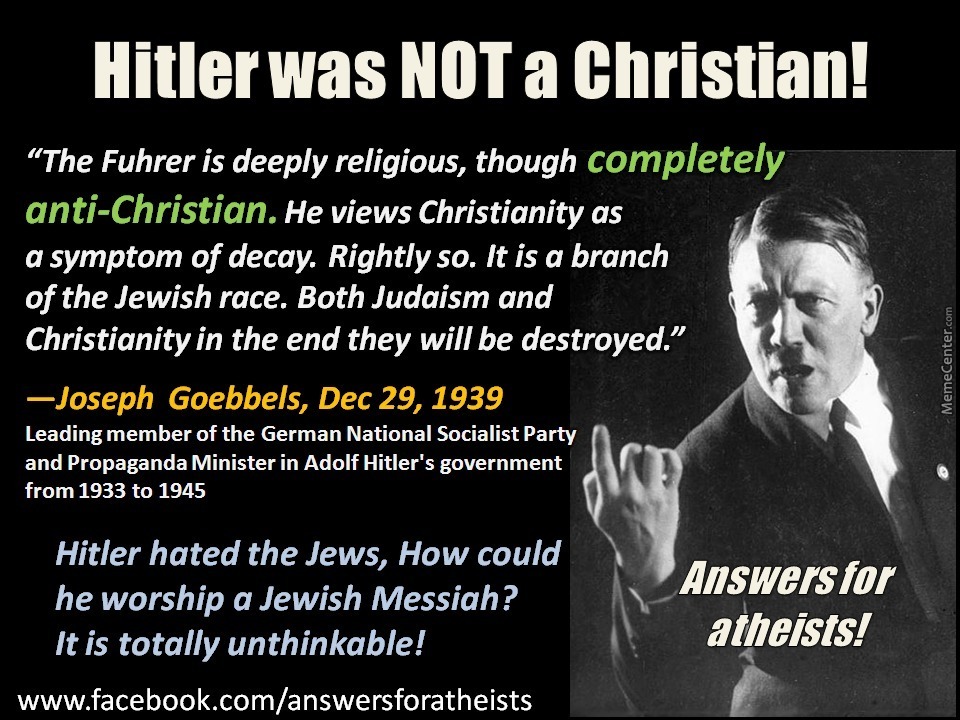
Terrible. Both Christians and atheists have this fascination of claiming Hitler was on the other team. And they do this by taking things out of context, and then by ignoring everything that disagrees with their view.
Let’s break this down. Hitler wasn’t a Christian. He was definitely anti-Christian. He was more of a pagan. He actively persecuted Christians as well as the Catholic Church. He detested Christianity.
But he wasn’t an atheist either. He was a theist, but he took on a pagan stance.
While he was rising in power, and even in the Mein Kampf, he did claim to be a Christian. But as the Nazis took power, they started promoting what was called positive Christianity, which really stripped Christianity of it’s foundations. Positive Christianity denied that Jesus was divine, rejected the Jewish elements of the religion, including the Old Testament, and even pitted Jesus as an Aryan fighter who fought against Jews.
Hitler did agree to a Reich concordant with the Vatican, but it was more of a show than anything else, as it generally ignored it and persecuted the Catholic Church anyway.
Hitler also didn’t like atheists though. He found them to be uneducated. But really, Hitler was infatuated with occultism, and had a belief in some sort of god that often was conflated with nature. So he was religious in some sense.
As for the last statement, many Christians hated the Jews, yet still worshiped Jesus. It wasn’t totally unthinkable for millions of Christians.
It’s true that computers have really evolved over time. But the evolution they show really isn’t accurate. A phone, which is somewhat of a computer, really isn’t the end all. My main computer is still quite large, and while I built it myself, it still falls far short of some of the supercomputers out there.
When speaking of supercomputers, some of them are still the size of a full room. So the meme is trying to make a point by being purposely dishonest.
This dishonest goes further as energy is much different that what they propose. Yes, oil is still a form of energy. We still have coal power plants. But we are increasingly moving towards solar and wind power, as well as hydroelectric power. There is a new push for nuclear energy that is highly effective, clean, and could be a massive game changer.
I’ll have a video coming out about this later on as well, but it’s dishonest to ignore that energy has changed over the years.
First, evolution isn’t anti-Christian, nor did Darwin think it was. He instead stated that one could be an ardent Theist and an evolutionist. This is a view that many Christians take today.
The whole conversion to Christianity on his death bed comes from one Lady Hope. Lady Hope probably never met Darwin, was not there at his death bed, and his kids completely reject the story, as do most historians.
Darwin was more of an agnostic in the last years of his life. His belief slowly slipped away during his life, but he ended up as an agnostic.
Really, this again is an appeal to authority, and one based on a false narrative.