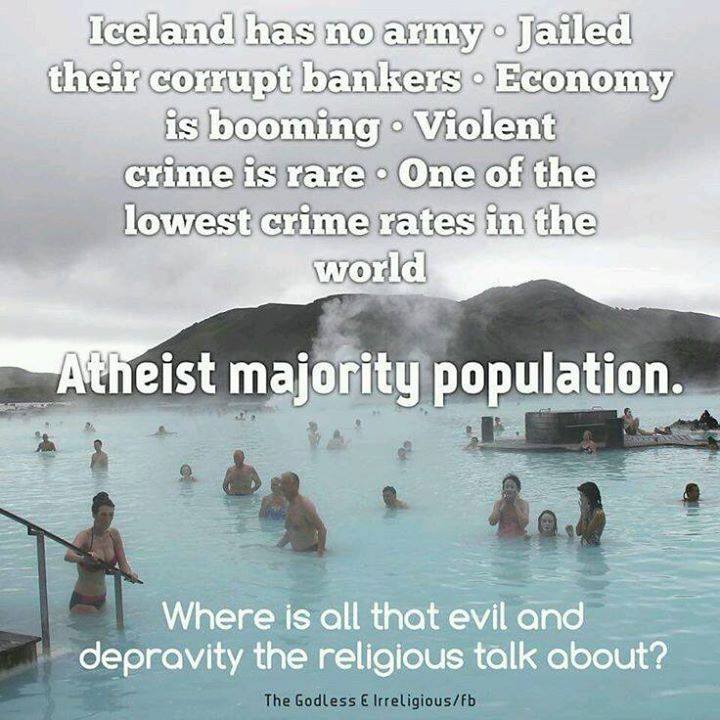
I’m not quite sure where the stats for this meme came from. Iceland doesn’t have a standing army. They did jail some corrupt bankers. Crime rates are among the lowest in the world. There economy is rising. But atheists only make up 10% of the country, while 80% identify as Lutheran.
There currently aren’t any countries that have a majority atheist population. China is the closest with 47% of the population being atheist.
So the foundation of the argument simply doesn’t work as it’s false. There is a bigger issue with the argument though, and that is cherry picking data.
Finding one country that has low crime, is prosperous, is morally good, doesn’t really say anything in general besides things are working there. Trying to find a correlation between a group of people and how the country is doing in general makes little sense as correlation is not causation.
In order to show that atheist countries are better, you’d have to find multiple countries that show this to be true, and that the major factor is atheism. Yet in Iceland, most of the population is Christian. The only country that comes close to being a majority atheist country is China, and they rank number 55 in crime rates.
In sum, the meme simply is wrong as Iceland is predominately Christian, and there are many more factors that come into play apart from the religious beliefs of the people.
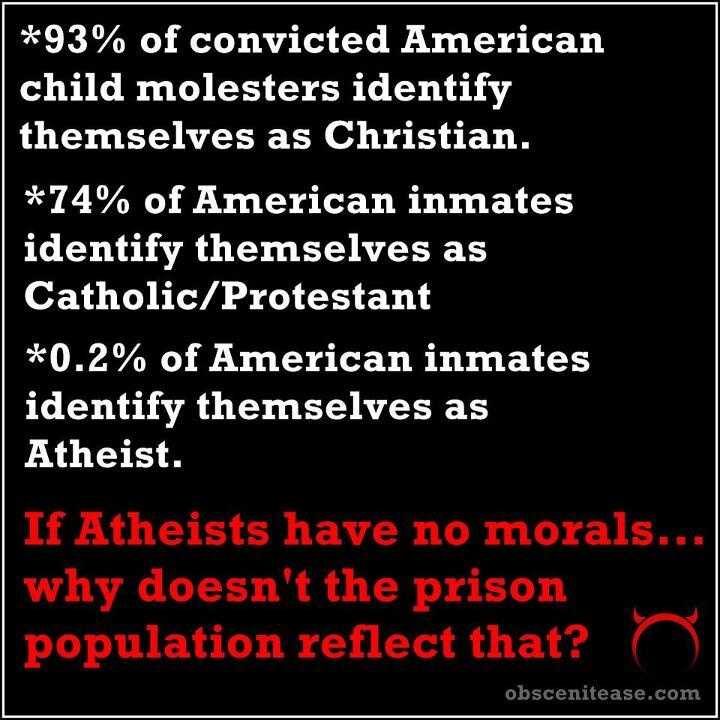
This really is just misunderstanding statistics. I won’t argue with the percentages, because whether they are correct or not doesn’t really matter. The problem is that if we are simply thinking of this logically, of course Christians are going to have higher percentages in these areas because the majority of the population identify as Christian. Atheists, on the other hand, will have low percentages here because they are a small minority of the population.
Really, this is exactly what one would suspect based on population statistics. The majority group will have a higher percent of many things simply because they are the majority. The argument that the meme makes then is fallacious as it’s not taking things into context.
The answer to this question is rather complicated. If we look at just the alcohol consumption in the United States before and after Prohibition, we do see that directly after prohibition was enacted, alcohol consumption plummeted. In 1919, the consumption of pure alcohol per capita was about .8 gallons. In 1921, it was just over .2 gallons, as shown by Clark Warburton in the Economic Results of Prohibition.
However, in 1922, that went up to just above .8 gallons per capita, and a year later, it was nearly 1.2 gallons per capita.
What Warburton shows us is that leading up to prohibition, the amount of alcohol being consumed per capita was already steadily lowering. While the enactment of prohibition would make that rate plummet, directly after enactment, the rate would rise once again, and level off around 1 gallon per capita. According to the World Health Organization, that level today is just over 2.2 gallons per capita. Now, to be fair, that is pretty far below the all time high in 1830, which according to W.J. Rorabaugh, in Alcohol in America, was 7 gallons per capita.
As I said though, alcohol consumption had been on a decline for nearly a decade. And looking at the number, prohibition only seemed to reduce the amount of alcohol consumed for just a single year. After that, it would once again increase and level out around 1 gallon per capita for a substantial amount of time.
But we do have to jump back just a bit. Those numbers can be a bit misleading. Rorabaugh, for instance, mentions that in 1850, alcohol consumption had dropped in half from 1830. As he points out though, it wasn’t that Americans were drinking less per person, but that half the population had stopped drinking. So half the population continued to drink just as much.
However, as suggested, by 1910, alcohol was dropping, as shown by Warburton. Or more specifically, the consumption of pure alcohol, per capita, in gallons, was decreasing. That’s a bit misleading again though. From 1900 to 1913, Americans were actually drinking more alcoholic beverages, but what was happening is that the consumption of hard liquor was declining, while consumption of beer was rising, as Jack Blocker in Consumption and Availability of Alcoholic Beverages in the United States, 1863–1920 demonstrates. By the time prohibition had gone into effect, the consumption of beer and hard liquor was virtually equal. This meant less pure alcohol consumed per capita, but the amount of alcoholic beverages had gone up (it was just weaker).
And here comes a problem. Mark Thorton, in Prohibition was a Failure, shows that during prohibition, that changed. The consumption of beer nearly disappeared, while hard liquor again started being consumed in higher amounts.
All in all though, when it came to decreasing alcohol consumption, Prohibition just didn’t work. The reduction in consumption was short lived, and it soon rose to levels higher than what it was just prior to prohibition. That was also partly because before prohibition, in the decade leading up to that time, alcohol consumption was already lowering. What prohibition did do though is cause a spike in the consumption of hard liquor, and nearly destroyed the beer industry.
The outcome was even worse though. As Thorton points out, federal convicts had risen by 561 percent during the period of prohibition, prison populations rose by 366 percent. Two-thirds of all prison inmates had alcohol related charges.
Anneliese Anderson, in Organized Crime, Mafia and Governments, also shows that because of Prohibition, the growth of the mafia in the United States grew not only in scope, but also power. Prohibition created a major illegal market for alcohol, and that market was filled largely by the mafia.
This is actually a very loaded question. For instance, can it actually be moonshine if it is legal? Many would say that it can’t be.
This is largely because the term moonshine, in and of itself, was associated with high-proof distilled spirits, that were produced illegally, without government authorization. What made a whiskey moonshine was that it was simply distributed illegally.
Now, moonshine is generally associated with a white whiskey, one that came to the U.S. with Scot-Irish immigrants, who made a clear, unaged whiskey, that, in English, was called the water of life. This alcohol was legal before prohibition, or could be legal (there were still liquor laws).
This sort of whiskey did not take on the name moonshine though until later on, and that was only as a slang term, which specifically associated it with being unauthorized by the government; by very definition of the slang term, moonshine was illegal. If it was legal, then it wasn’t moonshine by definition.
So the question becomes, if you legalize moonshine, is it moonshine? Some are adamant that it is no longer moonshine. However, the type of spirit that is associated with moonshine, generally a clear unaged whiskey (you can also have rum, or other high-proof distilled spirits as well) can be produced legally. So its the same liquor that is associated with moonshine, but whether one can call it moonshine is debated.
To sum up, moonshine, by the definition of the term, at least historically, has to be illegal. Moonshine is just a high-proof distilled spirit that is distributed illegally. This spirit can be different forms, but often is an unaged, clear, whiskey. The spirit itself has been made legally both before and after prohibition. Today though, there is a push to sell this spirit as a specific alcohol called moonshine, which changes the definition of the term.