Using anger and screaming is a way a narcissist tries to manipulate a person. Similar to a cat screaming when backed into a corner, or confronted with danger.
Growing up, my brothers and I were
manipulated by our birth mother. We are not necessarily different in
that. Many of us are manipulated at some point in time, and if you
have a narcissistic person in your life, manipulation is a common
ordeal.
Among us brothers, some of us broke
away from the manipulation sooner than others. The youngest of us was
the first to break away from our birth mother, and I, the oldest of
us three, was the last. But even breaking away from the person
doesn’t stop the attempts at manipulation. If you can spot them
though, you can reduce, or prevent their effectiveness.
One of the problems with manipulation
is that we are geared to be effected by it. Generally, we are more
prone to trust others, and at the same time, we have a tendency to
believe that we can’t be manipulated. This in itself opens us up to
manipulation. This can lead some to distrust everyone, which doesn’t
prevent manipulation, and over the long run, isn’t healthy.
So how do you figure out someone is
trying to manipulate you? Part of it is catching the individual in
their lies. For me, that was easy as our birth mother admitted to
being a compulsive liar. While we all could see some lies from time
to time, having her admit that she was a compulsive liar made
everything she said questionable. Here’s the thing though, even her
admitting that she is a compulsive liar was a form of manipulation.
This may seem counter intuitive, but it comes back to our innate predisposition to believe others. By her admitting that she is a compulsive liar, she is admitting a fault, and revealing the truth. At the same time, it’s accompanied by a promise that they will work on that. It’s meant to bring you in, and form a trust for them, as they are revealing a secret. It’s a small bit of truth, enough to pull you in, and not question them. For our birth mother, it had the opposite effect, and could be seen more as a last ditch effort on her part.
Another common tactic of manipulators
is to pull on your emotions. Crying, acting in a panic, and even
yelling can all effect your emotions, and by effecting your emotions,
it becomes easier to manipulate a person as you’re preoccupied. It
gets you to let your guard down, and once it’s down, it’s easier to
manipulate.
Part of the intimidation process is trying to keep a person quiet, and silenced.
This can eventually also lead into
somewhat of a good cop bad cop scenario, where the person acts as if
they are understanding, and then launches into anger, or into crying,
and then comes back to understanding. It plays with your emotions by
spiking them, and then giving you relief, only to spike them again,
which makes a person much more susceptible to manipulation as the
emotional and even physical toll on a person wears them down, making
it more difficult to fully process everything going on.
This sort of tactic often comes out
when the person is beginning to be found out. For our birth mother,
she would use this when she was confronted. When I finally broke the
ties, she did everything from admitting that she was at fault, to
then threatening to sue me, to harassing my wife, to screaming
obscenities.
Once you know there is manipulation going on
though, it become easier to combat it. With a narcissist, it can
often be a bit easier to spot it as well because they have such a
high view of themselves, they see themselves as intellectually
superior, and thus they see others as inferior. This often reminds me
of Michael Scott from the TV show The Office, where he attempts to
use reverse psychology. It’s clear to everyone else what he is doing,
but he believes he’s outsmarting others.
From our birth mother, we’ve seen it
quite often, especially since we started this page. Her tactic is to
make it appear as if she likes the fact that we created this page and
are speaking out, because it supposedly is helping her obtain
evidence that she will never show anyone. Yet we know that isn’t true
because actions speak much louder and she often reacts in anger,
which ends up showing what she truly thinks.
The goal of this sort of “reverse
psychology” is to make it seem as if speaking out, and exposing the
narcissist for who they are, is actually helping them, so you might
as well stop because it’s only hurting you. But the truth of the
matter is that the person is just trying to silence you. They want
you to be quite so that you don’t continue pealing away their lies.
Other forms of manipulation comes in
terms of intimidation. Threats of lawsuits, or threats of exposing
evidence are quite common. But the threats are almost always hollow
because the narcissist, or manipulator, doesn’t actually have a foot
to stand on. In our case, we’ve been waiting for the damning evidence
or court case for almost half a decade. It will never come though
because it doesn’t exist, but it’s meant to be intimidating.
Being aware that manipulation is going
on though is key, and once you realize what it is, you can combat it.
I
tend to see things in shades of gray. Maybe its because I like
debating with people, and with a lot of gray, there’s a lot of room
for disagreements. That or I just find black and white to be too
boring. I like having more substance, and room to explore.
However,
I understand black and white. Its easy. It gives definitive answers.
And it may just be part of human nature to see things in that manner.
For our ancestors, it was a huge benefit. It allowed them to make
efficient decisions that their survival depended on; this is a friend
as they are in my group, that is a foe as they are other.
It
is a trait that we are born with, and while at one time it may have
saved our ancestors lives, it also has caused a lot of trouble. Being
a historian, this issue pops up quite regularly. People have a
tendency to want to categorize themselves as good, or moral, and
those who differ as bad or immoral. Which may be somewhat fine, but
when that sort of view is used to define historical figures, often
the result is that those individuals become demonized.
Lets
face it. Very few people from history, when completely examined, can
be seen as perfectly good or moral. Even those who we idolize as
pillars have their dark sides, especially when judged according to
today’s sets of guidelines and morality. Simply, morality is
subjective and tends to change throughout history. While certain
guidelines may remain true, others just don’t stand the test of
time. Don’t kill, still a good idea. Lets enslave others, not so
good.
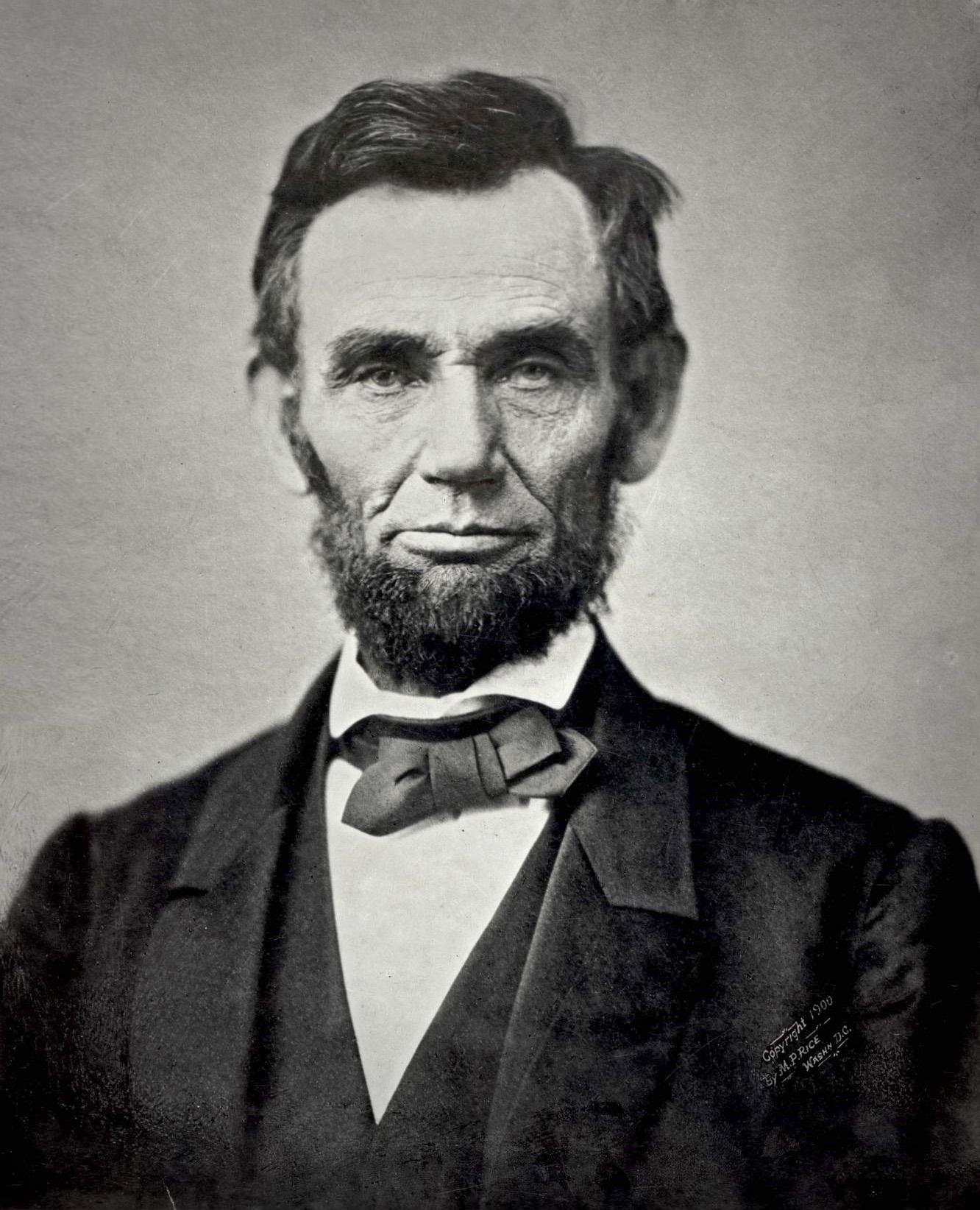
President Lincoln as photographed by Alexander Gardner in 1863.
Mr. Lincoln
Since
morality changes, as does what society views as acceptable or
unacceptable, to judge an individual on today’s standards often
isn’t justified, nor does it make sense. To be clear though, that
doesn’t mean people get a free pass because they lived 100 years
ago. But it does mean we should look at them in a different light. We
can’t simply retroject our views onto the past.
This
brings me to President Abraham Lincoln. Increasingly, Lincoln has
come under much more scrutiny, and at least in part, for good reason.
While at one time he was seen as this mythical hero of the United
States, and that view hasn’t completely vanished, increasingly, a
dark side of Lincoln has also come to light. For some, this dark side
is all that matters, and instead of a hero, he’s been recasted as a
tyrannical villain. But history is never so black and white.
To
be fair, Lincoln deserves a bit of both views. He led the country
through an incredibly difficult time period. He helped pave the way
for complete abolishment of slavery, and for greater equality of
black citizens. He helped unify the country, as well as better it
through things such as land grant colleges, which include most of our
public universities. And if you believe what you see in the movies,
he killed vampires.
But
for a good portion of his life, he was horribly racist. He oversaw
the largest mass execution in the country’s history; an execution
he signed off on. And he saw blacks as inferior, a point he was not
shy about when running for president. However, his views also changed
over time.
That’s
a key point. Lincoln changed over time. We all do. Our views evolve
as new information is introduced. And our views are also shaped by
the society in which we belong. To take one or two actions; a single
snapshot of history, and assume that is a good reflection of who
someone is, just doesn’t work. People are more complex than that.
Even
an event, such as the execution of 38 Dakota men, while a heinous
act, is more nuanced than just black or white.
Drawing of the execution of the Dakota 38 at Mankato, Minnesota, on December 26, 1862.
Dakota 38
In
August of 1862, an uprising by Dakota tribal members in Minnesota
began. It was in response to treaty violations and hunger, primarily.
To put it simply, the environment at that time was a tinderbox. For
six weeks, the Dakota War of 1862 waged on until the Dakota
surrendered at what later became known as Camp Release in Minnesota.
The uprising itself can be seen as justified. The United States had
violated treaties, which can be argued easily as a justification for
war.
United
States forces didn’t see it that way though. Just two days after the
surrender, a commission of military officers began trying Dakota men
who were accused of participating in the war. 392 prisoners would be
tried, and out of those, 303 sentenced to death and 16 given prison
terms.
However, earlier that year, in July of 1862, a new law
was passed that made it clear that the President would have to
approve any death sentences that came from military commissions. And
this is where all the gray area comes into play.
For
Lincoln, the easy route would have been to sign off on all of the
death sentences. That is what the people of Minnesota wanted, and
what the soldiers wanted. It is also what local politicians were
pushing for and in doing so, helped stoke a growing mob that was set
to implement vigilante justice if they didn’t get their way. Lincoln
was told, under no uncertain terms, that if he did not give the
orders for execution, the people of Minnesota, and possibly some of
the soldiers, would kill “all the Indians, old men, women and
children.”
In
December, he came to his decision. Only those who committed acts of
rape would be executed. After only discovering 2 men who were
convicted of such, he broadened the criteria to those who committed
massacres, making a clear distinction between those who just took
place in battles.
The
reason for this is one that would also largely be implemented at the
end of the Civil War. The goal was to not act in so much clemency, as
the fear was that it would encourage further uprisings. At the same
time, Lincoln didn’t want to act with so much severity that it would
be deemed cruel.
40
Dakota men would be convicted of this. One would immediately have his
death sentence commuted to ten years in prison, and a second would
later have his death sentence commuted.
It
is true that Lincoln could have commuted all of the 303 death
sentences. Instead, he commuted the death sentences of 264 men,
despite the intense pressure on him, and the very clear threat that
had been leveled if he didn’t do what the people of Minnesota wanted.
At the same time, while the Dakota justification for the war may be sound, not all of their actions can be excused. Rape, the killing of children and women, the killing of unarmed non combatants isn’t justified, on either side. Some 450-800 civilians, on the side of the United States, would be murdered during the war, which included children. To turn a blind eye, and paint all the actions of the Dakota as good, and all the actions of the United States as bad is a mistake and does no justice for the overall history. To put it simply, the entire incident is much more complicated then the black and white terms many try to paint it as.
Just as an aside, the decision that Lincoln made towards the Dakota, and the rationale behind it, also were in play with how the United States treated the South after the end of the Civil War. It isn’t uncommon for war tribunals to be held, and for people who went outside of the standard practices of war to be tried and imprisoned or executed.
As with the Civil War
After
the Civil War, this wasn’t an exception. Around a thousand tribunals
would be held after the War. The reasoning for such acts is simple;
they are to enforce the laws of war.
Like
the decision in the Dakota War of 1862, after the Civil War, leniency
was practiced. There would be prison sentences, as well as
executions, most famously Henry Wirz and a bit less famous, Robert
Kennedy. Champ Ferguson was another largely publicized execution
after the war, not to mention the many more executions during the war
(such as spurred on by General Order No. 252, in which Lincoln
promised to treat Confederate POWs in the same manner that Union
Black troops were treated when held as prisoners by the Confederates.
While Lincoln couldn’t keep the promise to the T, it did result in a
good number of executions as well as forced labor among Confederate
POWs).
The
decision was one of attempting to prevent another revolt by laying
down punishment, while not being so severe as to be cruel, because
reuniting and future peace was still needed. It was a fine line to
walk.
In
the end, history is much more complicated than the black and white
picture that it is often portrayed as. And we shouldn’t shy away from
that.
When speaking of Indians, there are two
main types of racism that comes out. The first is the obvious, the
negative stereotypes and portrayals of Indians, because they are
Indian. I’m not going to repeat any of those racist remarks, as we
all know what they are.
But there is another sort of racism
that is a bit more difficult to point out. I’d argue that it is just
as damaging though, if not more so. It’s the portrayal of Indians as
others. Looking at this photo, the view that is being portrayed is
this idea of a noble savage. This is a view that grew out of early
European contact with various tribes. As Europeans landed in North
America, they witnessed what they called pristine forests, that
seemed untouched.
Out of this, they began forming this
view of Indians having a special relationship with the environment.
That they were natural born ecologist. The idea becomes what is known
as the noble savage. The problem is that this view simply isn’t
historically accurate, and at the same time, it portrays Indians as
others. It dehumanizes them as it strips their humanity from them and
instead sees them more in a mythical manner.
Indians are humans like everyone else.
Some are environmentalists, and others aren’t. Some try to protect
the environment, and others pollute and destroy it. They are diverse,
have differing views, act in different manners. Simply, they are
humans.
If we look at the history of various
tribes in North America, we can find examples of both. One of the
examples I’m most familiar with is Pueblo Buenito in Chaco Canyon.
Here, the ancestral Puebloans built a massive city with immense
structures. It was a civilization that rivaled those in Europe at the
time and wouldn’t be matched in the US for centuries.
Building a city of that magnitude
required a massive amount of lumber. To feed the population, large
fields of crops were needed, which required immense irrigation
systems. This resulted in a couple of things.
Digital reconstruction of Pueblo Bonito by NASA
First, it resulted in massive
deforestation. At the time, the area was a thriving forest. But those
trees needed to be harvested for lumber, and as the city continued
growing, that meant moving further and further out. This wasn’t a
responsible foresting practice, but one that stripped the land of
every tree. The ancestral Puebloans would have seen that the last
trees were being removed from the canyon, and that did not stop what
they deemed to be progress.
Without the trees, erosion quickly
began and only worsened over time. This caused problems for the
irrigation system that was created to water their crops. Larger and
larger ruts were created, so the irrigation ditches would have to be
dug further down until they no longer worked. The final blow was a
drought to the area, and instead of changing anything, things
continued just as before. Until war broke out and violent atrocities
were committed.
The result today is an area that is a
desert, which will most likely never be able to produce fruit again.
It was a complete ecocide before Europeans ever stepped on the
continent. Pueblo Buenito isn’t the only example of this either.
Possibly the most famous example, while not dealing with the
Americas, is Easter Island. There, we see a forested island that was
destroyed. In order to set up statues, the island was deforested so
that those statutes could be moved. What’s most astonishing is that
Easter Island isn’t that large, and the inhabitants would have seen
that the last tree was being cut down.
Now the point of this isn’t to demonize
Indigenous peoples. It’s to show that they also majorly screw up just
like all humans do. They aren’t some natural ecologist. They aren’t
more in tune with the earth by birth. They aren’t noble savages or
some mythical beings. They are humans.
To portray Indians as others is really
just another way of using them as a mascot. And it paints a history
that doesn’t fit with the facts.
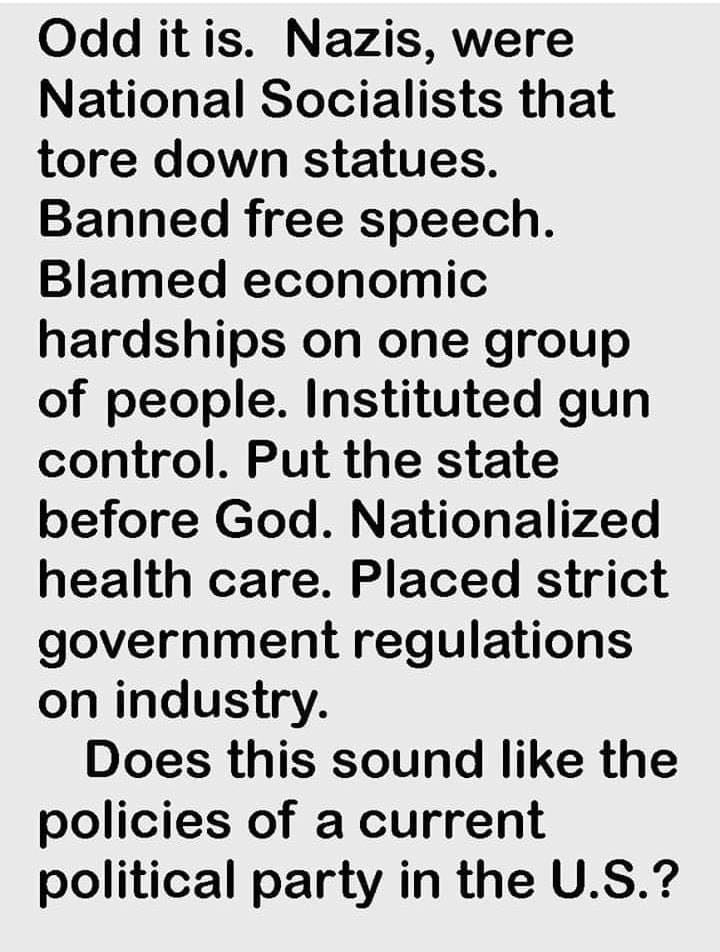
Failed History: Nazis and Hitler are a go to for many people. If they see a leader they don’t like, they compare them to Hitler. There are always some sort of comparison to how things are going and the how the Nazis formed. More often than not, the comparison is simply historically bankrupt. I’ll use a meme to showcase this.
I just want to first point out though
that the meme could be pointing the finger at either party. The
statement of God may swing it more to the right, but if we get rid of
it, both sides could post it with little problem.
To begin, I’m just going to say that I
agree with the first sentence. Odd it is. The accusations here are
quite odd for a variety of reasons. They are so vague, or some so
historically inaccurate, that the point they make makes no sense. We
can break them all down.
Not everyone is a Nazi, nor is every leader Hitler.
Nazis are Nazis
The first point that is made is
correct. Nazis (there should be no comma after the word Nazi) were
National Socialists. That is 100% true. But it is also redundant.
National Socialism was the ideology of the Nazis. While the
terminology was used prior to the Nazi party, National Socialism came
to be synonymous with Nazis. Literally, the first point is that Nazis
were Nazis.
The point they are trying to make is
quite different, and it has to do with socialism. And it may be
worthwhile to ask the question that is posed at the end of the meme;
what political party promotes or has adopted socialism? The answer is
both.
The United States is, in part, a
socialist country. Socialism isn’t a dirty word, but it is an
ideology that is often misunderstood. In the United States, socialism
takes the form of our public education system, or the police force.
Our fire department is a socialistic institution, as are most public
works. We can thank socialism for our public road ways. Socialism is
the most effective way for these institutions to exist.
For instance, we can look at the
history of fire departments. At one time, fire fighting was a private
industry. In order to have your home protected, you had to buy fire
insurance from a specific fire fighting organization. Most places
would have multiple such organizations. That means that if your house
would start on fire, and the wrong fire fighting organization was in
the area, they wouldn’t put out the fire unless you then bought their
fire insurance.
This was worsened as for a fire
fighting organization to make real money, you need to have fires and
you needed them to be common enough, and disastrous enough for your
services to be sought after. And through all this you had to fight
other organizations who were also offering the same service.
Companies accomplished this by setting fires, by committing arson and
then often extorting the money. It simply was a terrible system that
didn’t work.
Topping Saddam. Most agree it was alright to bring down this statue.
Tearing Down Statues
So to point two. The tearing down of
statues. Often when this is talked about, we currently think about
Confederate statues being torn down. The Nazis did tear down statues
that depicted ideologies that were at odds with them. When they
conquered a new area, statues would come down, and others would go
up. So that is true.
In context though, the point is odd.
After Nazi Germany was defeated, Nazi statues and monuments were torn
down, in part, by the US. Germany has since done a thorough job of
dismantling Nazi monuments. We have to also realize that the Germany
that replaced the Nazis was an entirely new government. This is
exceptionally common.
When Saddam’s regime was toppled in
Iraq, there is the famous images of a statue of Saddam being toppled.
US Marines helped with this, and the general reaction was praise. We
can look at another example that happened on July 9, 1776, in New
York. After reading the Declaration of Independence in a public
square, a group of patriots destroyed a statue of King George III.
The tearing down of statues is so
common that making the point that two parties did it is really a moot
point. But we can once again ask the question being posed, which
political party is doing that?
The answer is meant to be Democrats.
And it’s true that many Democrats are calling for Confederate statues
to be removed. But it’s not just Democrats. Republicans in Kentucky
have also called for Confederate statues to be removed. There has
been Republican governors calling for a statue of Jefferson Davis to
be removed. Both sides are calling for such statues to be removed.
Both sides claim that freedom of speech is being trampled on, but we often take to the streets to voice our displeasure, and we do that freely.
Banning Free Speech
Banning free speech is the next point.
Again, there is some truth that in Nazi Germany practiced censorship.
Free speech as a whole wasn’t banned, but it was regulated. The
United States has also regulated it to a point. We aren’t free to say
whatever we want. The consequences of speech are often weighed, and
at times, certain speech isn’t allowed or is punishable. Libel is a
form of speech that you can be sued for. But to be certain, Nazi
Germany went further.
But what current political party is
banning free speech? I have no idea, because it’s not happening. That
is why this point simply doesn’t work. However, I have been debating
this with others, and the argument appears that speech is being
banned on school campuses.
One thing that is often reported or
talked about are speakers being “banned” from giving speeches or
talks at certain college campuses. This has often been argued as an
attack on the freedom of speech. But it is also often blown out of
proportion. Since 2016, there are around 50 instances of speakers
being denied. The story has been blown out of proportion, but it does
happen.
Some of the biggest instances have been
with Conservative speakers who have had their talks canceled or have
been denied giving speeches. However, Liberal speakers aren’t immune
to this at all. When broken down, we see that both sorts of speakers
are being denied giving talks, and having their talks canceled. This
is generally happening at schools in the upper north east, and
Chicago. The vast majority of schools don’t have this problem, and no
one group is being singled out. And I think we are very fortunate
that most colleges don’t have this problem because opposing views can
be beneficial.
Children in a Holocaust concentration camp that were liberated by the Red Army.
Let’s Blame Others
The next point I find to be very odd.
It is true that the Nazis blamed Jews and other minorities for a
whole host of hardships. The Nazis didn’t invent this, as most of
Europe for centuries were saying the same things. Nazis adopted this,
and escalated it even further. That is a very important point as Nazi
Germany was not alone in the level of anti-Semitism they had. They
weren’t some unique government who sought to solve the Jewish
Question. We have to see them in context to understand the situation
that Jews found themselves.
Back to the question though, which
political party blames economic hardships on one group of people?
Sadly, this is a common occurrence in the United States, and both
parties have been guilty of it throughout their histories. In the US,
groups such as the Chinese, Japanese, Irish, Germans, Polish etc have
been blamed for the economic hardships of the US. What we are seeing
today really isn’t anything new, it’s just a different group/s being
blamed.
Today, we have both parties pointing their fingers. We have both the Republicans and Democrats pointing their fingers at each other for all the woes. Republicans are also pointing their finger at Mexicans, while many Democrats point their fingers at rich white guys. So again, both parties are guilty of this.
Gun Control One of the biggest points is the idea of gun control. This one simply is wrong, and illogical. After Germany lost WWI, part of the agreement in the Treaty of Versailles of 1919 is that Germany would disarm their country, and their people. Basically a full ban was put on gun ownership. This changed a bit in 1928 when a registration program was created. It was still rather strict, but allowed for a way to own guns legally.
The Nazis would take power in the mid
30s and by 1938, they got rid of the registration program for
everything but handguns. What the Nazis did was basically deregulate
gun ownership. They got rid of a lot of the gun control in the
country. This didn’t extend to everyone, such as those the Nazis saw
as enemies, including Jews.
Nazis opened up gun ownership and made
it a whole lot easier. But it didn’t matter, and if we think of this
logically, we can understand why. Jews made up about 1% of the
population of Germany. Every single Jew could have been given a gun,
and they still would have been a smaller army than what Germany had.
If they would have rebelled against Germany (and assuming that every
Jew participated, regardless of age, and somehow they were all able
to join together, instead of being dispersed, and all were in good
health, etc.) their army would still have been smaller than the Nazi
army. And the Nazi’s had tanks, and planes. And bombs.
We can put this into perspective in two
ways. In 1943, there was a rebellion in the Warsaw Ghetto. 13,000
Jews were killed, and the remaining were moved to concentration
camps. The Nazis, who were surprised by the attack, had 110
causalities, 17 of which died. The Jews had guns, molotov cocktails
and grenades. The Jews were helped by Polish resistance groups. The
resistance only lasted about a month, and in the ghetto’s place, a
new concentration camp emerged.
Here’s a second way to look at this.
When Germany attacked Russia, 7 million Russians would die in the
fight. And they had tanks and planes on their side. They were trained
soldiers, and it still took 7 million Russians to hold off the
Germans.
The fact of the matter is that even if
every Jew was armed and ready for a fight, the outcome wouldn’t have
been much different, besides possibly that the extermination of the
Jews would have been much quicker. And we can see this in genocide
after genocide.
Nazis and God
Probably the oddest claim though is the
one that states Nazis put the state before God. The problem is that
the Nazis weren’t running a theocracy. They weren’t a religious
organization, or a country founded on a religion. Many Nazis were
religious. But the government wasn’t religious.
The same is true for the United States. We aren’t a theocracy. But we have some Democrats and Republicans that are religious while others are non-religious.
Looking at health care.
Health Care and Regulations
Then we get to a historical inaccuracy. The claim is that Nazis nationalized health care. This is simply impossible as Bismarck had nationalized the health care system when Germany unified around a century earlier. It is true that both parties in the US are looking at health care reform, and some Democrats prefer a system based on socialized medicine, but Nazi didn’t do this. Germany had done that prior to the Nazis.
The final claim is that they placed strict government regulations on industry. The claim is so vague though. All governments put regulations on industry, because we can’t expect private industries to regulate themselves. It would be a massive conflict on interests. And in the United States, both parties support some regulations.
If we look at all of this, both
political parties fit the mold but mainly because the claims are so
vague or so general that they fit everyone. What’s worse though is
that some points simply are made up in order to force a supposed
connection, because connecting an idea to Nazism is a go to thing to
do.
Luckily, such memes simply are wrong.
We aren’t at risk of a new Nazi regime or a similar situation.
History doesn’t repeat itself. There are similarities, but they often
don’t mean anything because they are so general. It’s something we
can all be grateful for.
Finding similarities, and then jamming them all together, really just makes this meme inaccurate and misleading.
In college I majored in history and
religious studies. It’s a mix that can be exceptionally depressing.
Especially when you have courses like Religion and Violence, and for
some reason every course for a semester wants to focus on atrocities
in history. But to make sense of history, and religion, such a
background is needed. Looking at the events that led up to certain
atrocities, and the overlooked details is incredibly important to
understand the whys and hows.
This meme is missing that background,
and by doing so, portrays an argument that simply doesn’t work, and
amounts to a logical fallacy (in this case a version of the either/or
fallacy). By basing an argument on a false premise, it makes the
entire argument collapse, whether the sentiment is correct or not.
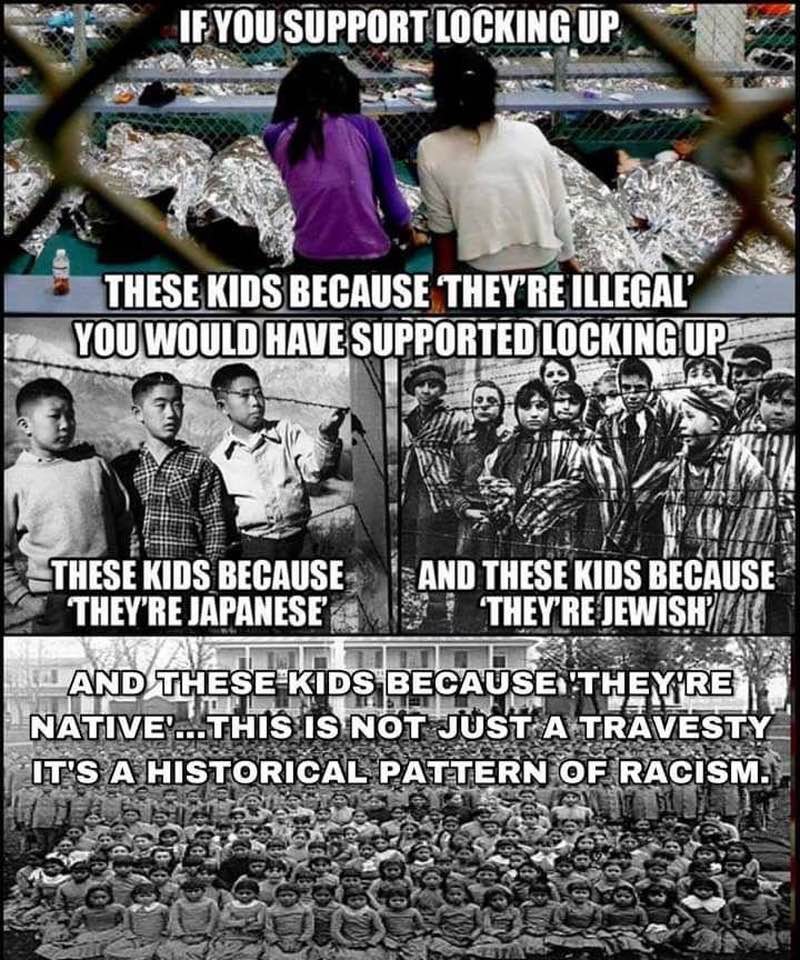
Breaking down this meme, the base
argument is that we as people have a history of locking up in mass
people who are a different perceived race, and the implication
appears that such locks ups are based strictly on race. The argument
centers around the idea of racism.
The argument doesn’t really work
though. We will start from the bottom up. The bottom photo shows a
group of children at the Carlisle Indian Industrial School around
1900. The purpose of these sorts of schools was two fold. First, they
were meant to assimilate Indian children and youth into American
society. Second, they were meant for basic education.
Pupils at the Carlisle Boarding School.
In 1891 this sort of schooling became
compulsive. For some, the school was right on reservation, but for
many others, it meant being taken from their families and shipped to
some far off boarding school. Part of the reason off-reservation
schools were set up was strictly to separate the child from their
community, which allowed for the assimilation process to take hold
easier. The goal was to civilize these children and youth, and strip
them of their culture.
The practice of sending Indian children
and youth to boarding schools was definitely based on racism, as well
as an idea that these children needed to be rescued from a life of
poverty and depression. The means of doing that, according to the
American government, was to teach them life skills and have them
adopt American culture.
During the course of these schools,
hundreds of thousands of Indian children would be taken from their
homes, stripped of their culture (many would return home unable to
speak to their families because they no longer knew their mother
tongue), and sadly, abuse ran rampant, and death or serious injury
wasn’t uncommon. This was truly an atrocity in our history.
There were some success stories that
came out of these schools though. Through this education process, a
number of Indian activist would rise out of the system and did untold
good for their communities and Indians in general. That was not the
intention of the schools, but it was one of the effects that it did
have, in which the children and youth took what they learned, and
used it to better argue for the rights of Indians. To be clear, that
doesn’t excuse anything, but I find it interesting.
But the meme over plays its hand here.
Its a minor point, but its a distinction that needs to be made so
that the history isn’t muddled. These children were definitely
targeted because they were Indian; they were targeted based on their
race. And while they were taken from their homes and their families,
the context is greatly different. They were shipped off to places of
education. They were able to return home. They weren’t deemed
criminals or children of criminals. They weren’t placed behind bars,
or in fences.
This was an atrocity, but it was so in
a very different way, with very different intentions. And I believe
the intentions matter because it helps us understand history. If we
look at the other three images, we are looking at not just children
being locked up, but also adults. We are seeing people who are deemed
criminals or as possible enemies. The political reasons are so vastly
different that what we are left with is simply a superficial
similarity.
I make this distinction because if we
are going to look at the atrocity that was these Indian boarding
schools, we need to do so from a historically accurate perspective.
We need to understand the whys behind them, or we simply won’t be
able to understand them at all.
Children in a Holocaust concentration camp that were liberated by the Red Army.
Holocaust
Moving up a photo, to the Jewish
children in a concentration camp, we are seeing something different
as well. Today, when speaking of being Jewish, it isn’t a racial
identity. It can be an ethnic or religious identity, but race
generally doesn’t become involved. During the 20th
century, as the Nazis came to power, there was a different view.
Today, it is largely acknowledged that
race is a biological myth. There is only one race; the human race.
But when thinking of race, it is usually based on color; black, red,
white and yellow. That is not how the Nazis, nor most of the world
saw it at the beginning of the 20th century. Instead, race
was also intertwined with a sociopolitical understanding.
Jews were not alone persecuted by the
Nazis. Eastern Europeans in general were seen as subhumans, including
the Romani, Poles, Serbs, and Russians. The British and French were
seen as lower classes that while they had some Aryan blood, it was
also mixed with blood from other races. Even southern Germany was
seen as being different and not pure. To put it simply, the idea of
race was a mess.
While Jews were deemed often the lowest
race, and persecuted to a greater extent, they were not alone, and we
can’t forget that others also suffered alongside them regardless of
race. The Nazis targeted Jews and people of races they thought were
inferior, but they also targeted anyone they thought was inferior,
including homosexuals and people of various religions such as Jehovah
Witnesses. We are talking about much more than race when looking at
the Holocaust.
There is another aspect here though.
Often it is portrayed as if Nazi Germany was unique in their
persecution of Jews; as if what happened during the Holocaust was a
sudden surprise. History shows us something much different. What the
Nazis were doing was dealing with what was called the Jewish
Question. This was a question that arose in Britain in the 1700s
because of the Jewish Naturalization Act of 1753, or what is know as
the Jew Bill.
To sum this up quickly, in 1745, the
Jacobite rising occurred, where Charles Edward Stuart kicked off a
rebellion in the attempt to have his father placed on the British
throne. As the rebellion occurred, Jews in Britain showed a great
deal of loyalty to the throne, and were responsible for not only
strengthening the stock market, but many volunteered to defend
London. To reward their service, there was an attempt to allow Jews
to become naturalized. The Jew Bill of 1753 passed, even though there
was a lot of opposition, but because of the outburst of antisemitism
that followed, it was repealed a year later.
It is out of
that that the Jewish Question forms. From there it spread throughout
Europe. It began to rise in popularity in Germany around 1843, with
the publication of The Jewish Question by Bruno Bauer. By 1898, the
suggestion in Germany was that Jews should be deported and have a new
state formed for them in Palestine. The idea of deportation was also
how the Nazis first dealt with the Jewish Question.
The Final Solution to the Jewish
Question, or simply the Final Solution, arose out of centuries of
persecution and antisemitism. The view that the Nazis had wasn’t
anything new. Looking at Russia, from 1791-1917, there was the Pale
of Settlement, an area where Jews in Russia were basically limited
to. Life there was incredibly difficult and persecution was common.
Jews there were the targets of pogroms and anti-Jewish riots.
Things were so bad that Baron Maurice
de Hirsch created the Jewish Colonization Association that helped
mass emigration of Jews not only from Russia, but other Eastern
European countries, so they could escape from the widespread
persecution they were facing. It was no simple task as the JCA had to
fight with other governments, such as the US and Argentina in order
to find places for these Jews to escape to, all because anti-Semitism
was so widespread.
This history is incredibly
important as the Holocaust was born from this environment. It wasn’t
something overly secret. It really didn’t need to be defended. People
knew what was happening, and most did nothing because they were Jews
and other undesirables. That is not the situation we are in today.
It’s not the environment we are in today.
Germans building barracks at a WWI internment camp.
Internment Camps
Moving over to the Japanese kids in
interment camps, we see an example that is much more dishonest. The
Japanese in the United States were rounded up and put into internment
camps during WWII. This though was not based on race. If we look at
internment camps in the United States, we first have to go back to
WWI.
On April 6, and again on November 16,
of 1917, then sitting president, Woodrow Wilson, issued sets of
regulations that put restrictions on German born men, over the age of
14, residents of the US. A year later, those same restrictions, which
included having to carry a registration card at all time, was imposed
on women as well. And then many of them were placed into interment
camps.
When the US entered WWII, the same
thing happened. As with WWI, it was the custom to label individuals
from countries we were at war with enemy aliens. This did apply to
the Japanese, but it also did to Germans and Italians. The enemy
alien classification also extended to individuals fleeing those
countries, including refugees as well as Jews from Germany.
Along with Germans being interned,
others were also placed into POW camps, as well as what amounted to
military work camps. These individuals were not deemed appropriate
for the military because of possible allegiance to the enemy, but the
government wasn’t going to simply let them get out of service either.
The move to move these individuals to
internment camps had nothing to do with race, but the fact that the
countries they came from were now at war with the US. This is
important to realize as the history of these internment camps are
often misunderstood and because of that, since there is such a focus
on race, those individuals of German and Italian descent are ignored.
Their stories aren’t being told, and they are slowly vanishing.
As with Jews though, it wasn’t just
children who were locked up. It was entire families who were locked
up because of the fact the US was at war. It’s still a travesty, but
it needs to be understood in context so that we can actually
understand the history and the whys that led up to it. To simply say
it was because of race is not historically accurate, and it ignores
the many others who faced the same situations.
Illegal Immigrants
Now to the top image. These kids are
illegal. That’s true. Their situations differ greatly. I won’t weigh
in whether the situation is okay or not. I won’t even get into the
question of whether or not race is the motivating factor here,
because I don’t think it is as simple as that. And hopefully this
post has shown that the pattern of racism that is trying to be
portrayed here is simply misunderstood. I’m not saying racism isn’t
involved with some people, but I can’t say that is true for all, or
even the major force.
What I want to get into is the logical
fallacy that this is all built on; a logical fallacy that instantly
makes a productive conversation impossible to be had. Most clearly,
it is trying to equate people who support locking up the kids in the
top photos with, lets be honest here, Nazis. Or at the very least,
Nazi sympathizers. There just is no way to really come back to a
conversation from there.
As an aside, I have to even object to
the word support. I know people who were in favor of detaining
migrants who were coming to the southern border. Most also objected
to separating the children from the parents, or at least were not
comfortable with it. They may not have had another solution in mind,
but to say they were in support really isn’t getting to the heart of
the matter. Words are important.
Here is the crux of the fallacy though.
Just because one supports, to whatever level, the locking up of some
children, it doesn’t automatically mean they support any other act
that has some general aspect that is similar. It would be similar to
saying that if you like chocolate ice cream, then you must also like
vanilla, strawberry and pickle flavor ice cream, because they are all
ice cream.
Such arguments have to be watched as it
alienates others, and prevents further discussion. It can also force
a person to take up a position more firmly then they previously would
have, simply because they feel as if they are being attacked.
People can approve of locking up of
other individuals for a variety of reasons. In the four situations
posed in the meme, the reasons for support were quite different, as
were the historical environment that each one occurred. To pretend
none of that exists does not serve any side, and only drives a wedge
further.
I grew up thinking that I had a high
tolerance to pain. The older I got, the more tolerance I thought I
had. Part of that reason is that I try not to complain about pain. I
don’t seem to have the same reactions as many do to pain. So in my
mind, it meant that I dealt with pain in a better manner, and thus my
tolerance was higher.
Lately though, I’ve been dealing with
increasing amounts of back pain, which stems from me missing a
portion of a disk in my back. So I decided to see if there was a
relation between pain tolerance and autism, as that is a new standard
that I simply do.
It turns out that I was wrong though.
The manner in which many people who have autism deal with pain is
different from those who don’t have autism. But they still feel that
pain, and sometimes more so than others. It’s not just physical pain
that is effected by this though, but the entire perception of pain
can be different.
Now, not everyone who has autism is
hypersensitive to pain. Even if they are hypersensitive to one form
of pain, it doesn’t necessarily mean they are hypersensitive to all
types of pain. Conversely, some with autism are hyposensitive, and
they experience one or multiple types of pain less. Simply, it’s a
bit of a mess when talking about pain perception and people with
autism. This gets more complicated when other issues are put into the
equation, such as various disorders that are more associated with
people with autism.
When autism was first defined, it was
believed that they didn’t feel pain. That was because those being
studied were observed doing things like going outside naked and
rolling around in the snow. They seemed impervious to both heat and
cold. And often, when inflicted with pain, they didn’t show the
common signs of pain. That view has changed, but studies still show
that children with autism are often not given the same sort of
attention that non-autism kids are because they don’t show that they
are in pain, or they can’t communicate what they are feeling
effectively.
That is one of the big points too; that
people with autism often lack the communication skills they need in
order to effectively let others know how they feel. They don’t talk
about it as others would. Their facial and body expressions often
don’t get the point across.
There is another thing at play though.
New studies are being done that are really looking at pain perception
in people with autism. One recent study compared brain imaging of
people who have autism, as well as others you did not, while they
were feeling pain. The study was relatively simple in that the
individuals would undergo an MRI while they had a piece of metal
strapped to their leg that would be heated up to a point where it was
painful, but not damaging.
Treating pain for someone with autism can be difficult as they may not know how to properly communicate their pain.
What the researchers found was that
both participants had the same area in the brain light up, an area
associated with processing pain, as the heat was beginning to ramp
up. But while the participant’s brain who didn’t have autism would
continue to be lit up, the brain with someone with autism would go
dark. The way that the brain handled pain was simply different. These
studies will need further research, as it is relatively new, but it’s
showing that someone who has autism has a brain that simply works
differently.
But it gets more complicated than that
as well. It’s not just physical pain that is perceived differently.
This can be even what most would consider an annoyance. One
researcher who is making breakthroughs in this field has autism
himself, and he describes that when he was young, his mom would
vacuum the floors, and it would set him off. It was too much. He
eventually learned to deal with this, but it resulted in him becoming
numb.
The reason for that is that he was
hypersensitive to noises, and to other stimuli, as many people with
autism are. This is complicated in that people with autism often have
a hard time distracting themselves, and instead they focus on the
annoyance, which intensifies it.
All of this means that people with
autism have to be treated differently from a medical standpoint,
while they also have to use different ways to cope. And that is all a
learning experience.
Abraham
Lincoln, the Great Emancipator who was also a colossal racist. He
fought for their freedom, or maybe that was a political stunt. And he
certainly didn’t think blacks should have the same rights as white
people. Except maybe soldiers. Well actually … eh its a bit
complicated. So let’s look at Lincoln and slavery.
As
with most people, Lincoln’s views changed over time. His views on
slavery and blacks in general were no exception. Unlike most people
though, his view evolved in a very public fashion, and because of
that we are left with a great deal of works that highlight his views
as they progressed.
The
problem with such a public evolution is that it becomes exceptionally
easy to cherry pick through his statements, and portray him in
whatever particular light one may want. With seeing things in black
and white coming natural, Lincoln is often regulated to either the
Great Emancipator, or a colossal racist, depending on the individual.
In
recent years, the pendulum has begun swinging more to the negative
side of the spectrum. Many historical figures, especially those with
a mythical standing, have seen similar fates. The mythology that
surrounds them has slowly been peeled back, and the person they were
is being explored. At times though, this causes an over correction,
where the person is rightly taken off of their pedestal, and then
unjustly pounded into dust. When in reality, the person generally
falls somewhere nearer to the center, with both their good qualities
as well as their bad ones.
Viewing
people in this manner, and painting a full picture is complicated.
And Lincoln is nothing but complicated.
It’s Complicated
One
thing that we can say about Lincoln is that his view on slavery being
immoral was rather early. According to Lincoln, he couldn’t remember
a time in which he didn’t think slavery was immoral. He grew up in a
family that opposed slavery, a family that attended a Separate
Baptists church, which was strictly opposed to slavery. Slavery would
also have a factor in his family moving from Kentucky to present day
Indiana, which was part of free territory.
As
early as 1837, Lincoln made his first public declaration against
slavery, as a 28 year old serving in the Illinois General Assembly.
Throughout his career, he would continue to speak out against
slavery. But then again its more complicated than that.
Lincoln
was no abolitionist. He found slavery morally wrong, but there was
also a problem, one that was quite large for Lincoln. Slavery was
sanctioned by the Constitution. The question that Lincoln faced, as
did many others, was, well what do you do about slavery then? In
1854, in his three hour speech in Peoria Illinois, he stated his
conundrum. He was morally, legally, and economically opposed to
slavery. But he admitted that in the current political system in
which he existed, he didn’t know what to do.
That
aspect of law was important to Lincoln, as can be seen in his legal
career. As a practicing lawyer, and an Illinois legislator, he would
be involved with a variety of cases involving slavery. Even though he
was open about his moral opposition to slavery, he found himself on
both sides of the issue with the clients that he represented. While
he found it morally wrong for a human to own another human, it was
still protected by the law, and it was his duty to abide by the law.
That’s
not to say that Lincoln didn’t try to work within the system for a
change. But then again, it gets complicated.
Lincoln
argued that when the founding fathers penned the phrase, “all men
are created equal,” that it applied to both blacks and whites
alike. But that didn’t mean he thought that they should have the same
political, or even social rights. In his fourth debate with Steven
Douglas, at Charleston Illinois, in 1858, he made it very clear what
his stance was on the matter. Douglas accused Lincoln of supporting
“negro equality.” Lincoln’s response, well simply, was racist:
“I will say then that I am not, nor ever have been in favor of bringing about in anyway the social and political equality of the white and black races — that I am not nor ever have been in favor of making voters or jurors of negroes, nor of qualifying them to hold office, nor to intermarry with white people; and I will say in addition to this that there is a physical difference between the white and black races which I believe will forever forbid the two races living together on terms of social and political equality. And inasmuch as they cannot so live, while they do remain together there must be the position of superior and inferior, and I, as much as any other man, am in favor of having the superior position assigned to the white race. I say upon this occasion I do not perceive that because the white man is to have the superior position the negro should be denied everything. “
Because of those views, Lincoln,
while finding slavery immoral, and wanting to abolish it, found the
best means to rid the United States of slavery completely was to have
the black population leave the United States and settle in either
Africa or Central America. It was the policy of colonization. It was
the view that his political heroes, Henry Clay and Thomas Jefferson,
also favored. Even up to August of 1862, as he was editing the
preliminary draft of the Emancipation Proclamation, Lincoln would
hold that view. In that month, he would bring together a delegation
of freed slaves with the hopes that they would support a colonization
play in Central America. He argued that because of their differences,
and the hostile attitudes of whites towards blacks, it was better for
both to be separated.
His argument didn’t go over very
well and sparked anger among both black leaders and abolitionists,
who argued that African-Americans were just as native to this
country, and because of that, deserved the same rights as whites.
Lincoln seemed to take the criticism to heart, and wouldn’t publicly
mention colonization again. He completely removed a mention to it in
an early draft of the Emancipation Proclamation.
However, colonization more dealt
with what to do after slavery ended; it didn’t really focus on how to
get rid of slavery. Lincoln believed, early on, that if slavery could
be contained, it would burn out. He also thought about possibly
repealing slavery gradually, and compensating slave owner for their
losses.
To put it simply, Lincoln had no
idea what to do about slavery. He campaigned actively against slavery
in Kansas. Vehemently opposed the Kansas-Nebraska act, of 1854, an
opposition that helped propel him on to a wider stage. He found
slavery to be morally wrong. But how to get rid of it, and what to do
with former slaves was not an easy question for Lincoln, and one that
took him a long time to figure out.
President Lincoln as photographed by Alexander Gardner in 1863.
Two Events
But we need to take a moment to
step back and look at two events that really helped Lincoln’s
evolution on the subject, and pushed him to work harder on the issue.
The first was the Dred Scott case in 1857. The case made it clear
that no black person, free or slave, could become a United States
citizen, and thus could not petition a court for their freedom. But
it went further. According to Chief Justice Roger Taney, and his
allies on the court, the federal government did not have the
authority to even prohibit slavery in the territories it ruled. More
so, Taney also rejected the idea that free states could give freedom
to the slaves who were within their borders.
With the huge conquest of Mexican
territory in the Southwest, the country had grown considerably, and
because of that, coupled with Taney’s new doctrine via Dred Scott
case, there was fear that containing slavery would be impractical,
and thus it would continue strong. Joining the Republican party, the
central point that Lincoln believed the new party should organize
around was the opposition to any expansion of slavery, and by doing
so, choke off the institution, and hopefully alter the balance
between slave and free states so that the Constitution could be
amended, and slavery be abolished. It was a long game for Lincoln.
In 1858, Lincoln would take this
view to the public, when he accepted the Republican nomination to run
for the United States Senate, against Stephen Douglas. Even though at
the time, the public did not vote for senate members (instead they
were elected by the State legislature up until 1913), Lincoln and
Douglas took their fight to the public with the now famous
Lincoln-Douglas debates of 1858.
Lincoln would cite the Dred Scott case by name, and it was that ruling he had in mind when he made one of his most famous speeches:
“A house divided against itself cannot stand. I believe this government cannot endure, permanently, half slave and half free. I do not expect the Union to be dissolved. I do not expect the house to fall. But I do expect it will cease to be divided. It will become all one thing or all the other. Either the opponents of slavery will arrest the further spread of it, and place it where the public mind shall rest in the belief that it is in the course of ultimate extinction; or its advocates will push it forward, till it shall become lawful in all the States, old as well as new — North as well as South.”
As pointed out before, Lincoln
would say some racist things during those debates, after being
accused of supporting “negro equality,” but he also made clear
his view:
” I have never said anything to the contrary, but I hold that notwithstanding all this, there is no reason in the world why the negro is not entitled to all the natural rights enumerated in the Declaration of Independence, the right to life, liberty and the pursuit of happiness. I hold that he is as much entitled to these as the white man. I agree with Judge Douglas he is not my equal in many respects — certainly not in color, perhaps not in moral or intellectual endowment. But in the right to eat the bread, without leave of anybody else, which his own hand earns, he is my equal and the equal of Judge Douglas, and the equal of every living man. “
Lincoln would loose the senate
election, but the Dred Scott case would remain the center of both
constitutional and historical debates. It would also push Lincoln
further, and helped lead to his election, and the Civil War.
This brings us to the second major event that helped shaped Lincoln’s evolution; the Civil War. While the Civil War was never fought to abolish slavery, slavery was intimately tied to it. In their declarations of cessation, all of the states that left the Union made it clear that slavery was at the forefront of the reasons. Because of that, from the very beginning of the Civil War, the Union was forced to deal with the issue of slavery. As slaves fled the Confederate States, the question the federal government was faced with is what are we to do with these people? The solution was that the government was going to treat them as if they were free, because they weren’t going to send them back.
This also opened up the Army to
the enlistment of black men, and for Lincoln, that move, that blacks
were fighting to keep the country together, made him promote at least
partial suffrage; that black men who served the country deserved the
right to vote. But it was more than just the right to vote that
changed with Lincoln.
With the Civil War, and slaves
running towards Union lines, the question of slavery was on the
national agenda and had to be dealt with. With black men joining the
fight to help preserve the Union, as Lincoln saw it, it really was a
stimulus for him to begin changing his racial attitudes, and to see
America as more of an interracial society.
That
was never Lincoln’s intention for the war though. His goal was imply
to save the Union, and do so in the shortest way possible as provided
by the Constitution. As he wrote to the New York Tribune editor,
Horace Greeley, “My
paramount object in this struggle is to save the Union, and is not
either to save or to destroy slavery. If I could save the Union
without freeing any slave I would do it, and if I could save it by
freeing all the slaves I would do it; and if I could save it by
freeing some and leaving others alone I would also do that.”
In
closing the letter though, he made a clear distinction: “I
have here stated my purpose according to my view of official duty;
and I intend no modification of my oft-expressed personal wish that
all men every where could be free.”
It
was his duty as president that he had to stick with, regardless of
his own personal feelings. That duty, for Lincoln, dictated that he
preserve the Union.
But
this did set the road to emancipation and allowed for the abolition
of slavery.
One
of the first steps towards this was the Emancipation Proclamation.
Largely, it was a military tool. It didn’t technically free any
slaves, but did two other things. First, it undermined the
Confederacy. The Emancipation Proclamation would only really go into
effect when the south was defeated and rejoined the union. At that
time, slaves in those states would be free. It gave hope to slaves
living within the Confederate states that they could be free. Now,
this didn’t extend to slaves in the border states that didn’t go to
war, or even in areas of the Confederacy that were already under
Union control.
The
proclamation changed fundamentally the nature of the war, and turned
it into a war for freedom. This had a secondary effect, where it
prompted a greater exodus of slaves out of the south, and into the
Union. And with that, Lincoln provided a new source of manpower. He
allowed the liberated to then become the liberators.
A color slide depicting John Wilkes Booth just before he assassinated President Lincoln.
Times Change
As
the war ended, the question of slavery still loomed large though. It
was partially abolished, but it still hung in somewhat of a limbo.
Before the war, changing the Constitution in order to allow the
abolishment seemed like an impossibility. There was no way a
Constitutional Amendment would have passed pre-Civil War, and thus
the end of slavery would have been a long drawn out process.
With
the war though, the south took themselves out of the equation. At the
end of the war though, Lincoln knew he had to act quick, and that in
order to end slavery, he would have to follow the Emancipation
Proclamation with a Constitutional Amendment.
Before
the south was restored into the Union, the 13th
Amendment was proposed. It was thought that its passage would be
quick and easy through Congress. But the House threw a wrench into
the mix. For Lincoln though, the issue was of tantamount importance.
The country had the ability to abolish slavery, and he took it upon
himself to ensure the passage of the 13th
Amendment. He insisted it become part of the Republican platform for
the upcoming Presidential election, and his efforts would finally be
met with success. In January of 1865, the 13th
Amendment was passed, and it would be followed up by the 14th
and 15th.
Now
clearly, Lincoln wasn’t an untarnished hero, a mythical figure. He
was flawed and had some very racist views. But as we have seen, he
was also a complicated figure who held complicated beliefs. He was
wholly human. He, as most people, existed within a lot of gray area.
And that is all without mentioning that he grew up in a very
different time, with very different ideas. Which we have to factor
in. But in the end, for all of the good and the bad, he struggled to
do what was right. His views may not always have been morally sound
in today’s opinion, nor were all of his actions. But it also doesn’t
make him a monster, and it certainly doesn’t take away from the very
important contributions he made.
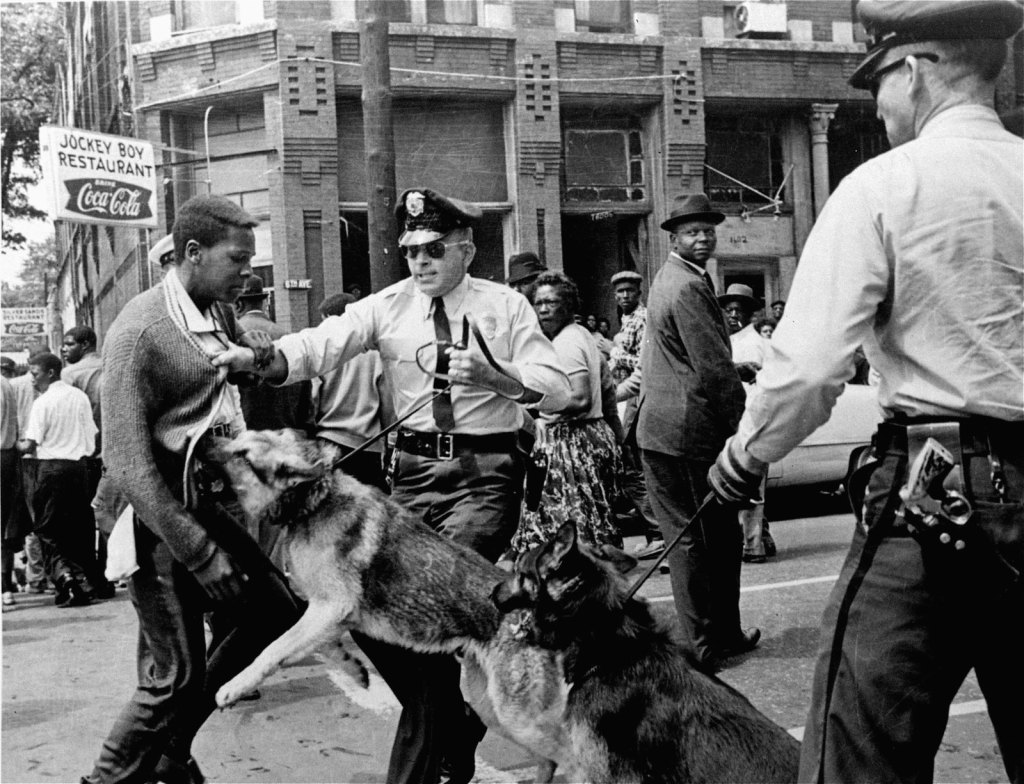
Walter Gadsen and R.E. Middleton in a photo that has told a million tales.
Awhile
back, I read an article called “Are you sure you’re not
racist?,” that had been shared. It was a fascinating article,
and got me thinking.
After
the Civil Rights movement, it seems that many people thought that the
race issue was over. Well, at least some people. That view has
continued through to today. Instead of talking about racism,
euphemisms or glossing over the facts are used. It is something
hidden beneath the surface, either by poor history, or by ignoring
the topic.
Part
of this is because of the media, and depending on what they want to
further, the narrative changes. In this picture, which has become an
iconic image of the Civil Rights movement, the initial story may
appear as if an African American man is the victim of purposeful
police brutality through the use of a dog. The truth is much more
complicated.
Walter Gadsen is the man in the photo. He was 15
years old at the time of the photo. The police officer was R.E.
Middleton. Both agreed that the narrative that was spread through the
United States, the story told by the photo, simply wasn’t true.
Gadsen
had nothing to do with the Civil Rights Movement. In later
interviews, he would go as far as to claim that it did nothing for
him or his family. He was neither impressed with the photo, or the
later sculpture inspired by the image. It was a fake narrative, which
just caused problems for him.
The
reason for that is because Gadsen was present simply to watch the
protest. He wanted nothing to do with it, and was even a bit
resentful that Martin Luther King Jr. started it. He wasn’t a foot
soldier in the movement, just a teenager, who according to Gadsen,
was running with the wrong crowd, and decided to skip school that
day.
It
would be by accident that Gadsen and Middleton would meet, and
according to both parties, it seemed to be more of a surprise than
anything. Trying to avoid the protestors, Gadsen had sought to rejoin
the spectators, and accidentally found himself among the police. He
would bump into Middleton, and the iconic image would be captured.
At
the moment in which the photo was taken, a complicated set of motions
were occurring. Startled by the dog, Gadsen reflexively kneed the dog
in the chest, while Middleton attempted to restrain the dog, and in
the process, both men grabbed onto each other out of surprise as well
as support.
That’s
not to say that police brutality didn’t happen that day, but just
that the iconic photo related a story that was very different.
Gadsen’s major problem with the incident is that his parents would
see it in the next day’s newspaper, and would know that he was
skipping school. Yet, both individuals would be plagued by the photo
for the rest of their lives.
The
image is nonetheless powerful, but as is often the case, the truth is
much more complicated than it may appear. Another great example of
this is the topic of segregation.
The 101st Airborne Division ensuring the safety of black students.
Desegregation
In
1954, the landmark case, Brown vs the Board of Education, was
decided. The Supreme Court declared that the establishment of
separate schools for black and white children was unconstitutional.
For many, it seemed like a right step forward, but in practice, it
caused even more problems.
The
motivation for the case wasn’t that black schools were necessarily
worse, but instead, it was the principal of the matter. It was the
fact that government funded public schools had the right to deny
enrollment based on the color of the students skin. That wasn’t how
the court saw it though.
For
the Supreme Court, the segregation of public schools had “a
detrimental effect upon the colored children.” The effect they saw
was that it had a “tendency to [retard] the educational and mental
development of negro children….” Yet desegregation never produced
the leaps and bounds that were predicted for black students. Instead,
in many cases, it led to problems.
With
the move towards integration, dozens of schools would close.
Specifically, it was the former black schools the closed their doors,
and with that closing, tens of thousands of black teachers would lose
their jobs. The situation really has never recovered.
The
firings were devastating, as teaching was one of the few professions
available to educated African Americans. Their future options were
very limited. And the firings would continue, even though many of the
black teachers were better qualified then their white counterparts.
For
the students, the black education tradition would nearly be
destroyed. Over the more than half century since the case was
decided, studies continue to reveal that black students do not
receive the same advantages as their white counterparts. Part of that
has to do with the lack of black teachers, as well as an
institutional racism that has seeped into the system.
Self-Licensing
Part
of the issue can be explained by moral self-licensing. A 2009 study
demonstrated that individuals who were given an opportunity to
endorse Barack Obama were more likely to express views that favored
whites over blacks. Simply, the effect made people feel that if they
demonstrated that they weren’t bias, it gave them licensing to
express prejudicial views.
Because
many view us as living in a post racial age, or because we feel as if
we have already demonstrated that we aren’t racist, future racism
becomes justified. How can it be racism if we’ve already shown we
aren’t racist?
Possibly
the largest issue though is that the topic of racism is often seen as
off limits. Instead of having an open discussion, we spend more time
trying to figure out the correct terms to use, or how to properly
label others. We refuse to acknowledge that racism continues to
exist, and instead of examining it, we use euphemisms, and gloss over
history.